



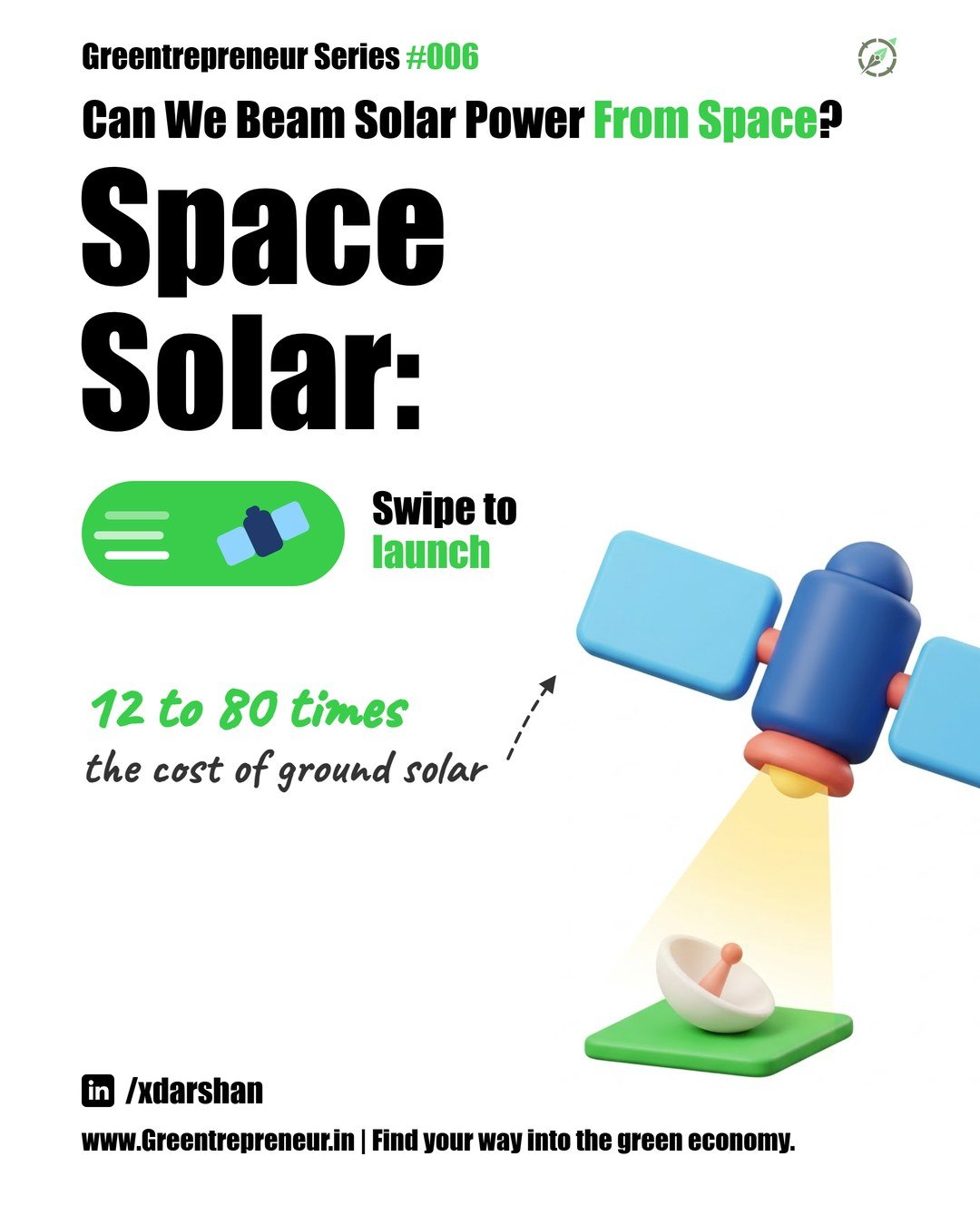
Space solar has no night and no clouds. So why does NASA say it costs 12 to 80 times more?
The sun never sets in orbit. The hard parts are the rockets, the beam and the price.
On 1 October 2026, a small satellite called Protostar launched on a SpaceX rideshare. It belongs to Star Catcher, a US company, and it will try to beam power in orbit.
The idea is old and simple. Put solar panels where the sun never sets, and send the power down. A NASA study says that, today, it would cost 12 to 80 times more than wind and solar on the ground.
Key numbers
Sources: NASA solar irradiance (2019); Singularity Hub (Oct 2026); NASA Office of Technology, Policy and Strategy (2024); CAE (May 2026); pv magazine USA (2025).
Why put panels in space?
Above the air, sunlight is 1,361 watts on every square metre. It is steady all year. Over an 11-year solar cycle it changes by only about 0.1%.
There is no night, no cloud and no season. That is the dream: power that never stops.
What has really worked so far?
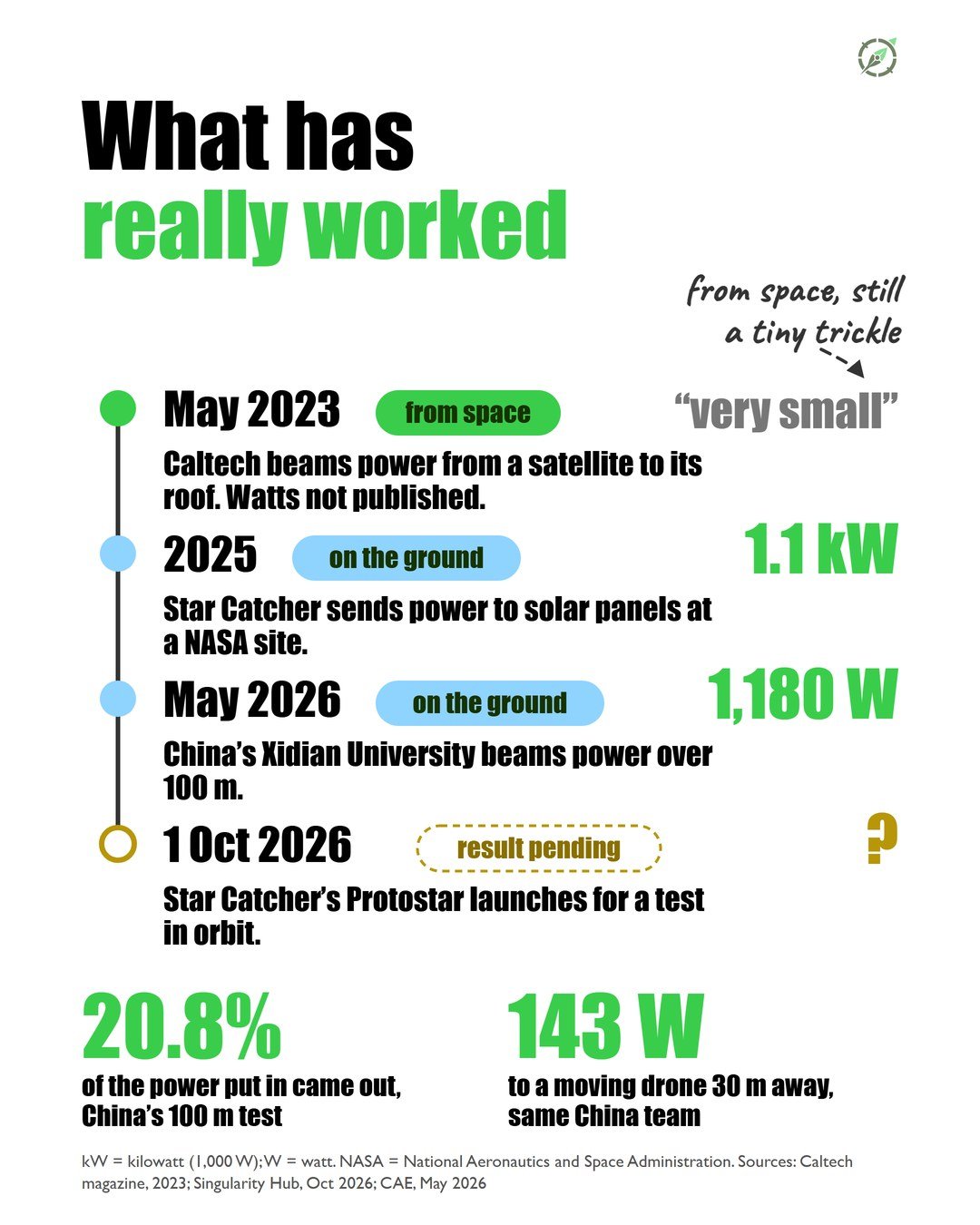
Not much, and not at scale. In May 2023, Caltech detected power beamed from its test satellite on a roof in California. The lead researcher said the level of energy was "very small at this point". Caltech did not publish the watts, and I will not guess.
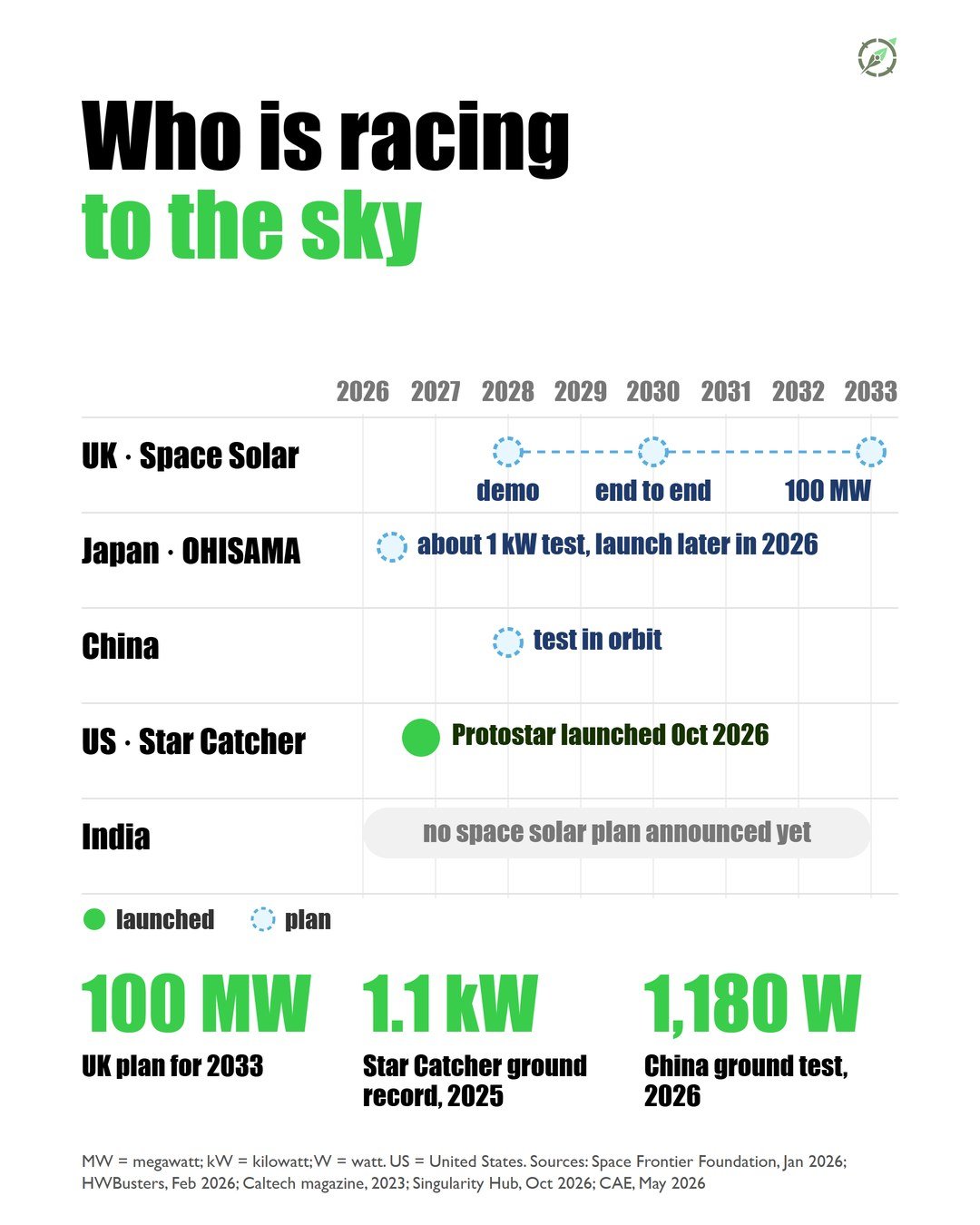
The bigger numbers come from tests on the ground. In 2025, Star Catcher sent 1.1 kW to ordinary solar panels at a NASA site in Florida.
In May 2026, China's Xidian University beamed 1,180 W over 100 metres. Only 20.8% of the power put in came out. The same team sent 143 W to a moving drone 30 metres away.
Think about what that efficiency means. Nearly four-fifths of the power was lost on a 100 metre hop. A beam from orbit has a far longer hop. So the beam and the ground receiver matter as much as the panel.
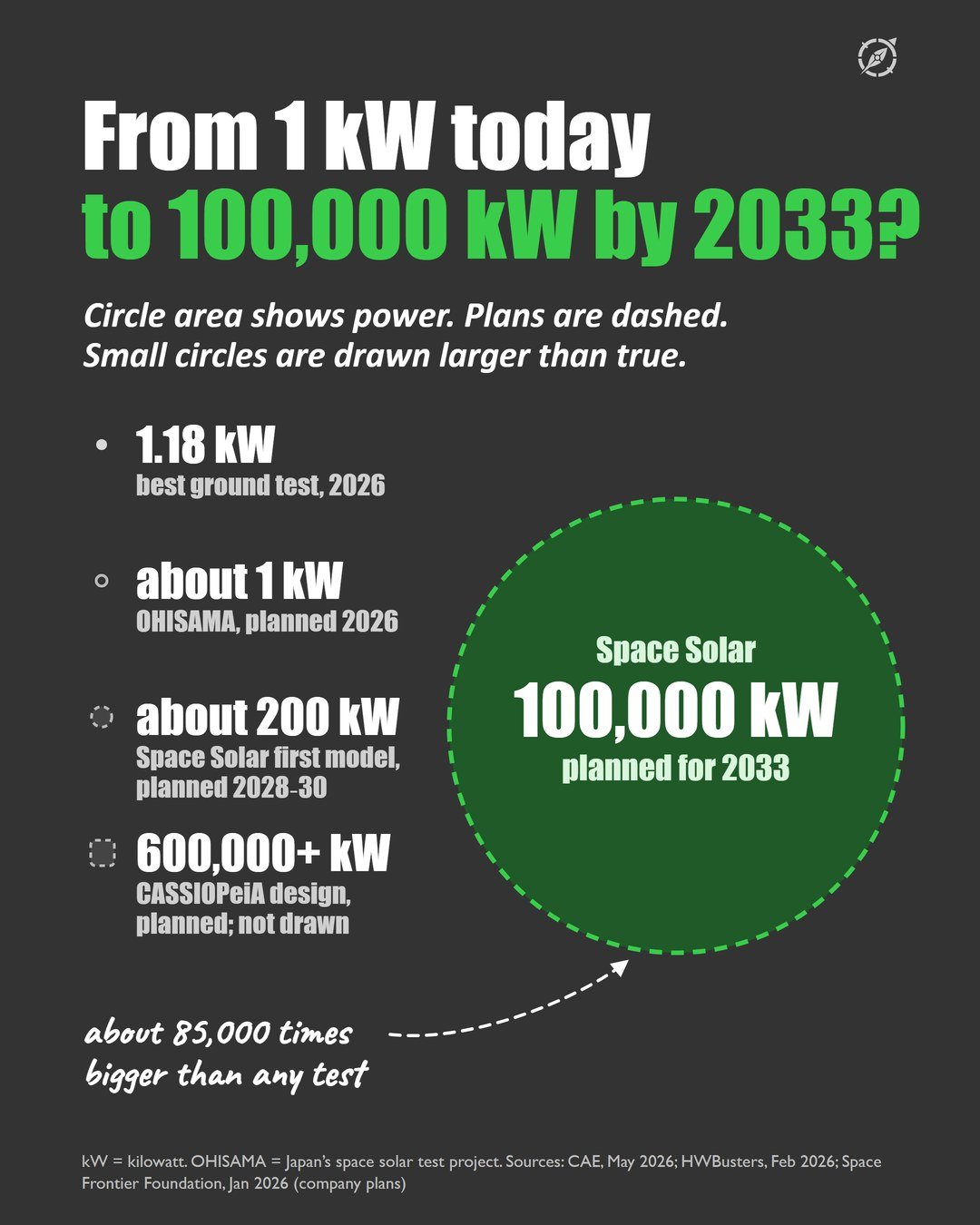
So the best test so far is about 1 kW. That is about what a kettle draws.
The best test so far is about one kettle. The plans are a power plant.
How big are the plans?
Space Solar, a UK company, plans 100,000 kW (100 MW) by 2033. That is about 85,000 times the best test so far. Its first small model is planned for 2028 to 2030.
The company has raised only about $7 million in grants and angel money. Its first commercial-class product would orbit about 1,200 km up and give a few MW at peak, or about 200 kW steadily. These are company plans, not results.
Japan's OHISAMA project plans a test of about 1 kW, scheduled for later in 2026. I could not confirm that it has launched. Japan's long goal is 1 GW in 25 years.
China says it wants kilometre-scale arrays in the 2030s, and a Caltech article mentions an orbital trial planned for 2028. India has announced no space solar plan that I could find.
Others have made promises too. In 2024, Orbital Composites and Virtus Solis said they would try a demo as soon as 2027 and reach megawatt class by 2030. Aetherflux booked a SpaceX launch for 2026, but I found no confirmation that it flew.
Each date I found is a plan from the company itself. Dates in this field have slipped before. Japan's OHISAMA was first reported for 2025, then moved to 2026.
The story in 10 slides



What does NASA say it would cost?
NASA's Office of Technology, Policy and Strategy studied two designs in 2024. The cost per unit of electricity came out at ₹58 to ₹151 per kWh from space. Wind and solar on the ground in 2050 are expected at ₹2 to ₹5. (I use ₹95.2 to the dollar.)
That puts the first design at 12 to 31 times, and the second at 32 to 80 times, the ground price.
The UK company has its own claim: about ₹3 a unit at today's launch prices. That is a company estimate, not a demonstrated cost, and it sits far below NASA's.
Why is it so expensive?
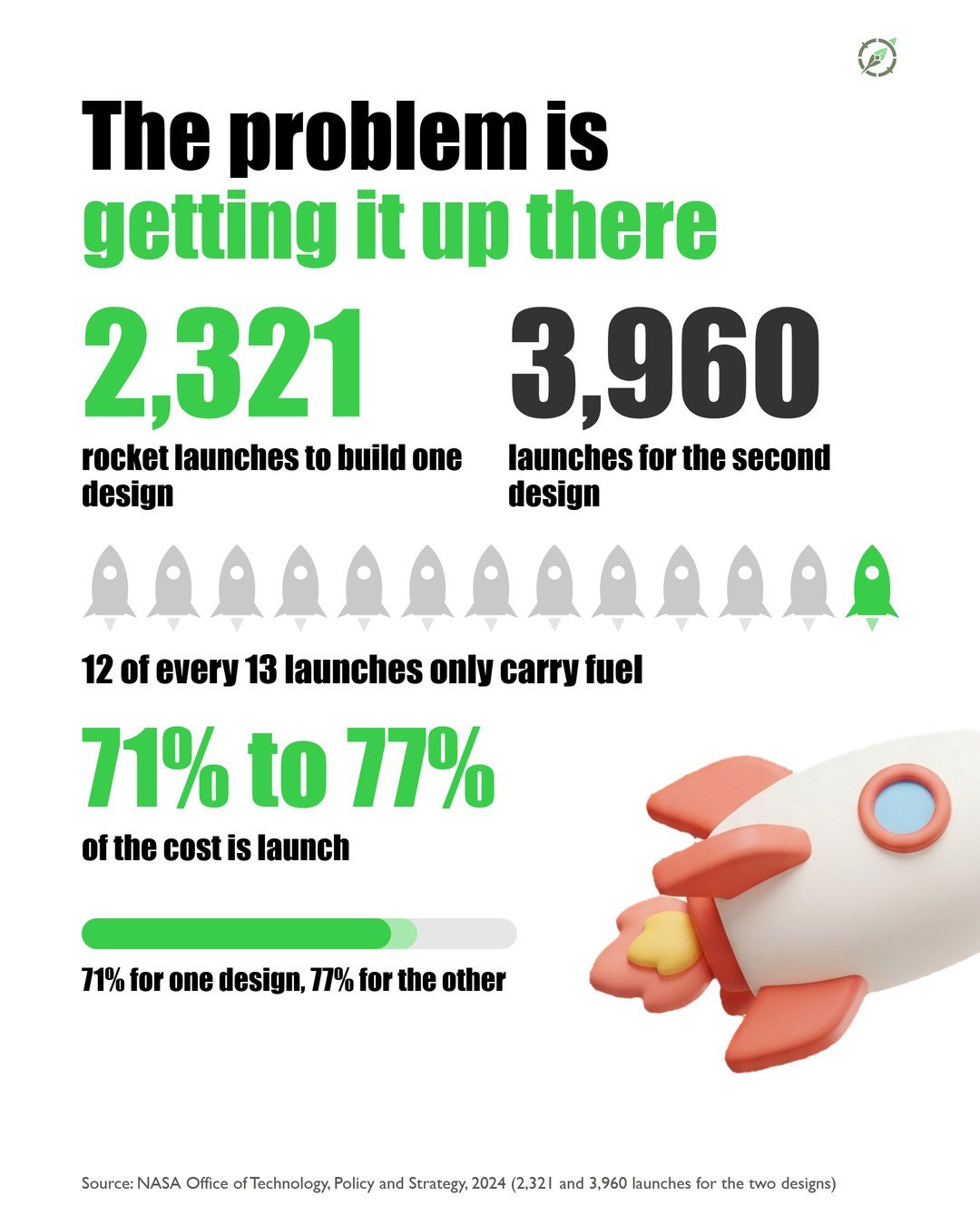
The reason is launch. One design would need 2,321 rocket launches to build. The other would need 3,960. Of every 13 launches, 12 would only carry fuel.
Launch makes up 71% to 77% of the cost. So the whole question is how cheap a rocket can get.
What would make it pay?
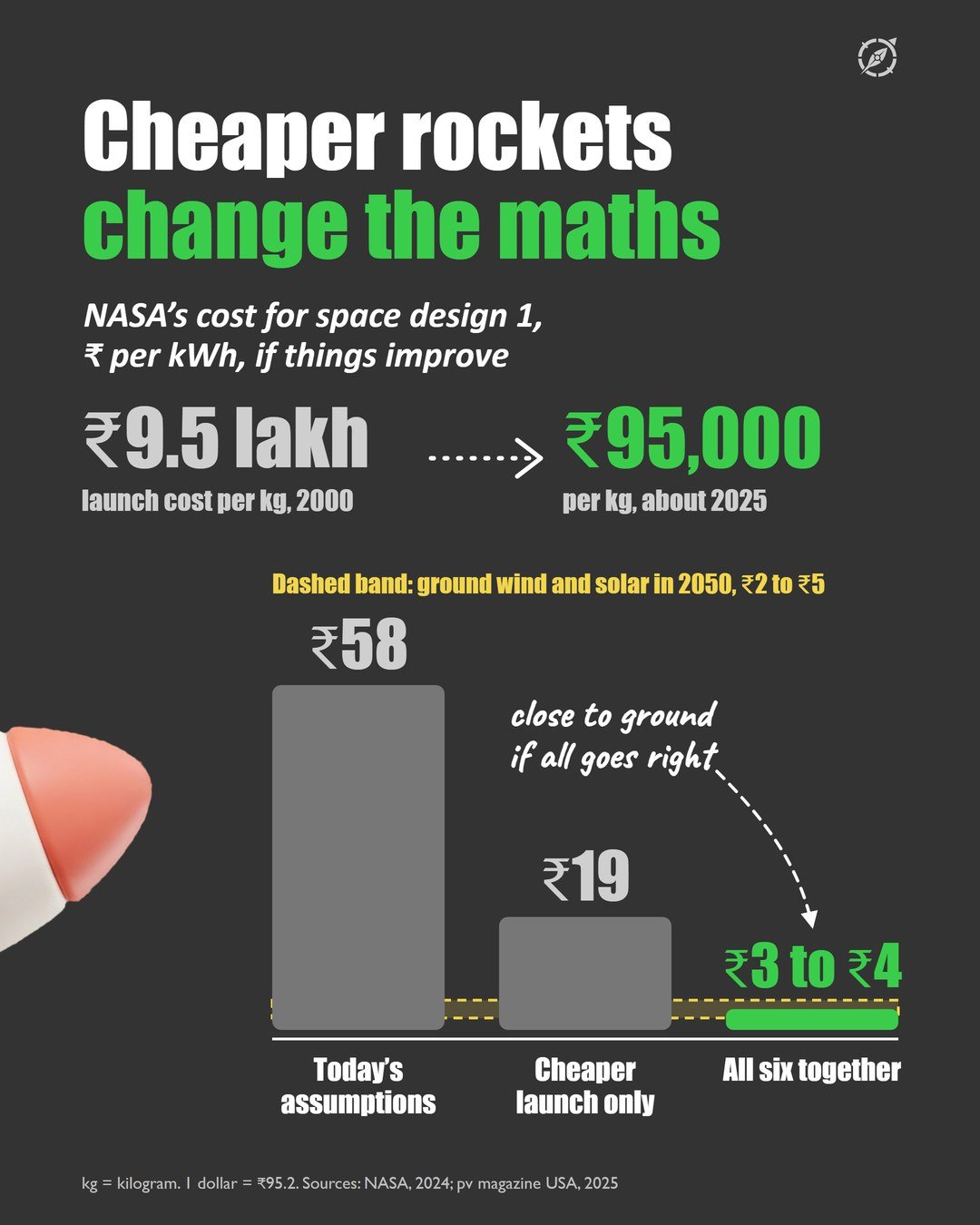
Cheaper rockets. Launch cost per kilogram fell from about ₹9.5 lakh in 2000 to about ₹95,000 in 2025. That is a fall of about ten times.
NASA tested what happens if things improve. With cheaper launch alone, the first design falls from ₹58 to ₹19 per kWh. If six things improve together, it falls to about ₹3 to ₹4.
That is close to ground power. But NASA's own report gives two slightly different figures for it, so I read it as a range, and it needs everything to go right.
Where the long race starts
- Cheaper launch. Launch cost per kilogram fell from about ₹9.5 lakh in 2000 to about ₹95,000 in 2025.
- Lighter hardware. Launch makes up 71% to 77% of the cost, so less weight cuts the biggest line.
- Beaming and receivers. Power beaming and ground receivers must be invented first, and they pay first.
- Stay patient. It is not a near-term market, and I would not plan a business on 2030.
The parts that must be invented first are the ones that pay first.
I think space solar is a long race that has only just started.
One day the sky's power may come down to earth; first, the price has to come down.
Questions
What is space-based solar power?
It means solar panels in orbit that send power to Earth, usually by microwaves or lasers. Above the air, sunlight is steady all year.
Has anyone beamed power from space to Earth?
Caltech detected power from a satellite on its roof in May 2023, but called the amount "very small". The larger tests, about 1 kW, were done on the ground.
How much would space solar cost?
NASA's 2024 study gave ₹58 to ₹151 per kWh for two space designs. It gave ₹2 to ₹5 for ground wind and solar in 2050.
Sources
- Space-Based Solar Power, NASA Office of Technology, Policy and Strategy (2024)
- Caltech Space Solar Power Project, Caltech magazine (2023)
- Star Catcher is about to beam power between two satellites, Singularity Hub (2026)
- Xidian University ground test, Chinese Academy of Engineering (2026)
- Solar irradiance science, NASA (2019)
Show the other 3 sources
Corrections: none so far. Found a mistake? Email me and I will fix it and note it here.