



One AI answer uses less power than 9 seconds of TV. So is AI's power bill a real problem?
A typical answer is a tiny sip. Yet data centres used 17% more electricity in 2025, and big tech is now buying nuclear plants.
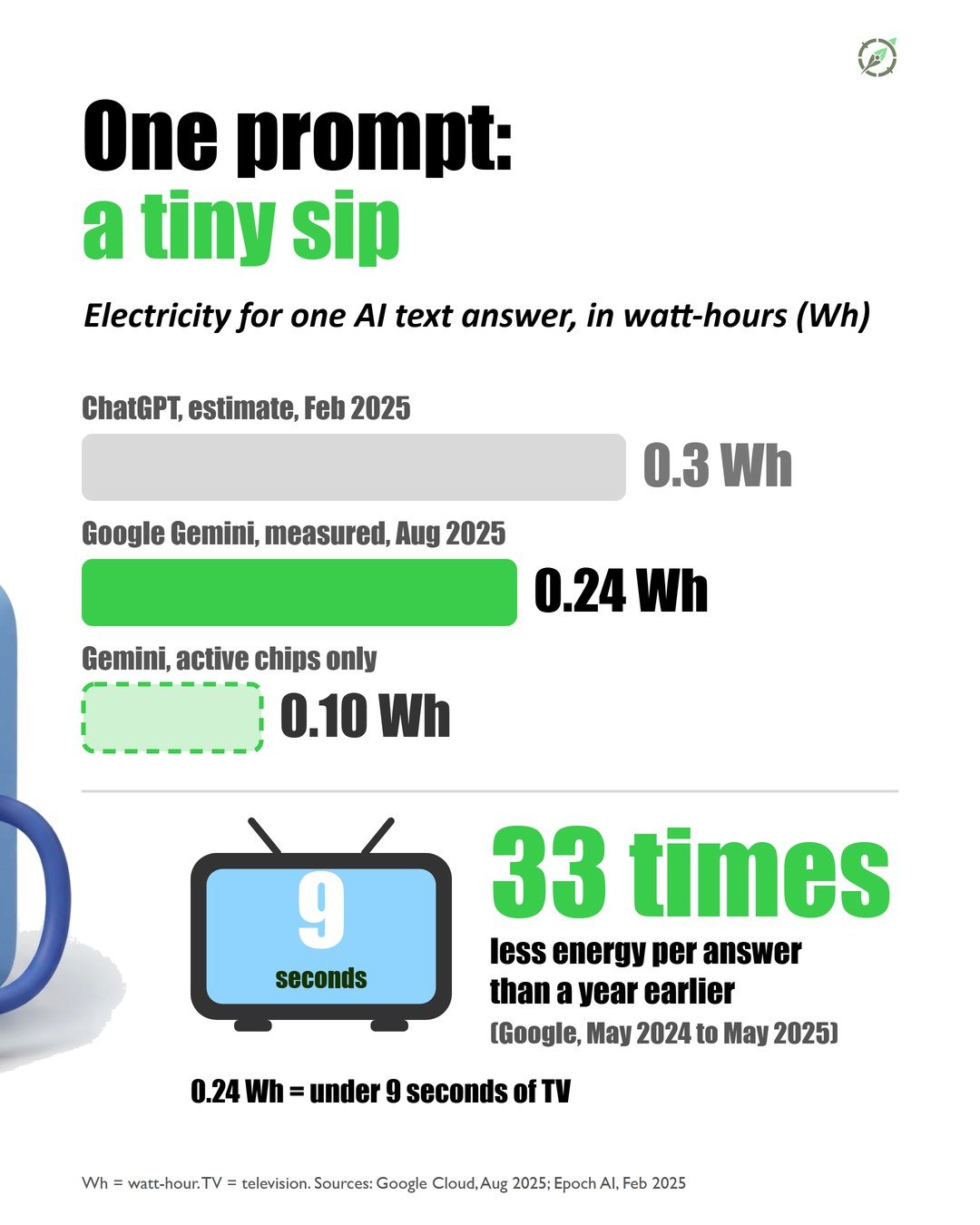
Google says one typical AI text answer uses 0.24 watt-hours, That is less than 9 seconds of TV. Yet data centres' electricity use grew 17% in 2025.
So is AI's power bill a real problem, or just hype?
Key numbers
Sources: Google Cloud (2025); IEA (2025); Rigzone (2026); w.media (2026); American Nuclear Society (2026).
How much power does one prompt use?
Very little. Google measured 0.24 Wh for a typical Gemini text answer in August 2025. If you count only the active chips, it is 0.10 Wh. The higher figure counts the rest of the machine room too, which is why I quote both.
Epoch AI estimated about 0.3 Wh for ChatGPT in February 2025. That one is an estimate, not a measurement.
Google also says its energy per answer fell 33 times in a year, from May 2024 to May 2025. So no, one question is not a climate crime, and you do not need to stop asking. The trouble is how many of them there are.
Do the sips add up?
They do. The International Energy Agency (IEA) says the world's data centres used about 415 TWh in 2024, about 1.5% of world electricity. A TWh is a billion units, the same units on your bill.
In its base case, the IEA expects 945 TWh by 2030. That is 2.3 times more than in 2024, and more than Japan uses today.
The range is wide. For 2035, the IEA sees about 1,200 TWh, with cases from 700 to 1,700. Data-centre demand has grown about 12% a year since 2017, over 4 times faster than all electricity.
In April 2026, the IEA said data-centre demand soared by 17% in 2025. A newer IEA edition says it is set to double by 2030. I use the 2025 numbers because I could read them in full.
Where is it happening?
Almost half of it is in the United States: 45% of the world's data-centre electricity in 2024. China had 25%, Europe 15% and the rest of the world 15%.
US data centres used 4.4% of the country's power in 2023. The US Department of Energy says that could reach 6.7% to 12% by 2028.
One answer is a sip. The world's servers are a river.
Is AI the biggest new load?
This is the myth to drop, and the data is clear on it. Data centres are only about 1 in 10 units of new world demand to 2030. Industry, air conditioning, electric vehicles and more add the other nine.
The picture changes in rich countries. There, the IEA says data centres are more than a fifth of demand growth. So AI is not the main driver of the world's demand. In wealthy countries it is a big one.
The story in 10 slides




What about India?
India's data centres grew from 375 MW in 2020 to about 1,500 MW in 2025. That is about 4 times in five years. Mumbai alone grew 42% in one year.
The government expects data centres to need 13.56 GW by 2031-32. Deloitte estimates 40 to 50 TWh extra a year for AI data centres by 2030, with 47 GW in the pipeline.
Today the figure is about 1.5 GW. So the plans are many times bigger than what exists. A plan is a request for power, not a connection to it, and the power has to come from somewhere.
India's grid still runs mostly on fossil fuel. So the question of clean power is not abstract. Every new data centre adds to a grid that is still cleaning up.
Is big tech turning to nuclear?
Yes. Meta's deals add up to 6,600 MW by 2035. The biggest pieces are TerraPower at 2,800 MW, Oklo at up to 1,200 MW and Vistra at 433 MW.
An old plant is coming back too. Crane, at 835 MW, is set to restart in 2027. In June 2026, the US regulator FERC let 760 MW of grid link rights move to it.
The plant is due to be fully operational before the end of 2030.
Why nuclear? A data centre runs day and night, and solar and wind do not. Nuclear gives steady power with little CO2 at the plant. That is my reading of the choice, not a quote from the companies.
Google also has a 50 MW deal for Kairos power through the Tennessee Valley Authority.
How India's data centres open a market
- Clean power. India's data centres grew from 375 MW in 2020 to about 1,500 MW in 2025.
- Grid tech. The government expects data centres to need 13.56 GW by 2031-32.
- Steady supply. Meta's nuclear deals add up to 6,600 MW by 2035.
- Ask who supplies it. Every new data centre adds to a grid that still runs mostly on fossil fuel.
I think the useful question for a founder is not how often people ask AI. It is who supplies the clean power behind each answer, and how fast the grid can add it.
I think the power behind each answer matters more than how often we ask.
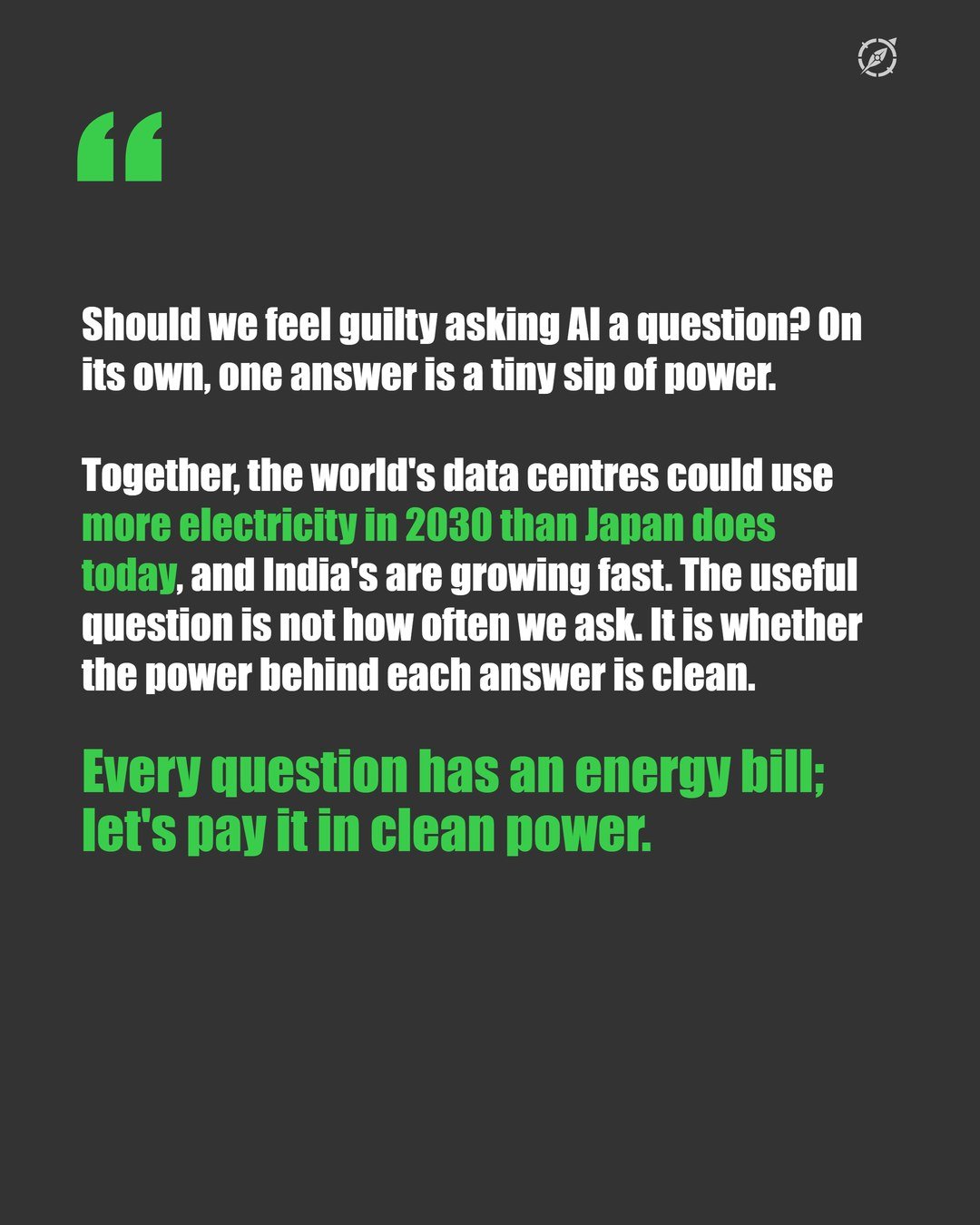
Every question has an energy bill; let's pay it in clean power.
Questions
How much electricity does one AI prompt use?
Google measured 0.24 Wh for a typical Gemini text answer. Epoch AI estimated about 0.3 Wh for ChatGPT. For comparison, 0.24 Wh runs a TV for under 9 seconds.
How much electricity do data centres use?
The IEA says about 415 TWh in 2024, or about 1.5% of world electricity. Its base case is 945 TWh by 2030.
Is AI the biggest cause of rising electricity demand?
No. The IEA says data centres are about 1 in 10 units of new demand to 2030. Industry, air conditioning and electric vehicles add more.
Sources
- Energy and AI, executive summary, IEA (2025)
- Data center electricity use surges, Rigzone (2026)
- Measuring the environmental impact of AI inference, Google Cloud (2025)
- How much energy does ChatGPT use, Epoch AI (2025)
- DOE releases new report evaluating increase in electricity demand from data centers, US Department of Energy (2024)
Show the other 5 sources
- India's data centre capacity almost touched 1.5 GW in 2025, w.media (2026)
- India AI data centre energy and sustainability to 2030, Outlook Business (2025)
- Meta strikes deals with Vistra, Oklo, TerraPower, American Nuclear Society (2026)
- FERC waiver clears way for Crane Clean Energy interconnection, World Nuclear News (2026)
- A new collaboration among Kairos, TVA and Google, American Nuclear Society (2025)
Corrections: none so far. Found a mistake? Email me and I will fix it and note it here.