



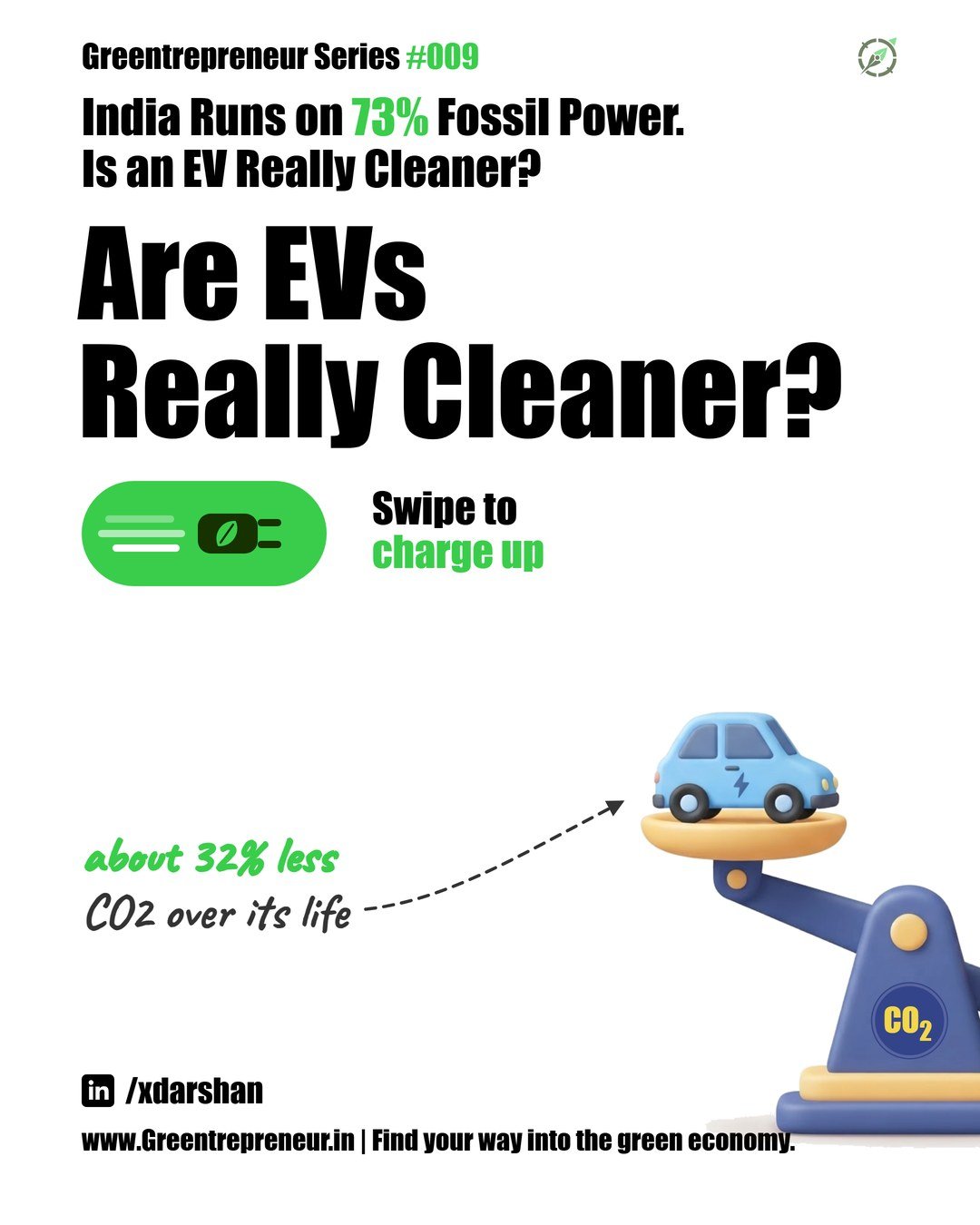
India's power is 73% fossil. Is an electric car just a coal car with a plug?
A 2025 IIT Madras study says no. Over its life, a battery car on today's grid emits about a third less CO2 than a petrol car.
73% of India's electricity still came from fossil fuels in 2025. So is an electric car here just a coal car with a plug?
A 2025 IIT Madras study says no. Over its life, a battery car on India's grid emits about 32% less CO2 than a petrol car.
The study, by IIT Madras with ITEL labs, looked at the full life of a car, from the factory to the scrapyard.
Lifecycle matters here. A study that counted only tailpipe smoke would flatter the EV, and one that ignored the grid would flatter petrol. This one counts the factory and the power, so it is the fair test.
That 32% is my sum from the study's own totals, so you can check it yourself below.
Key numbers
Sources: IIT Madras with ITEL (2025), via IamRenew; IANS (2025); Ember (2025 data); CREA (2026); Down To Earth (2025).
Is the grid really that dirty?
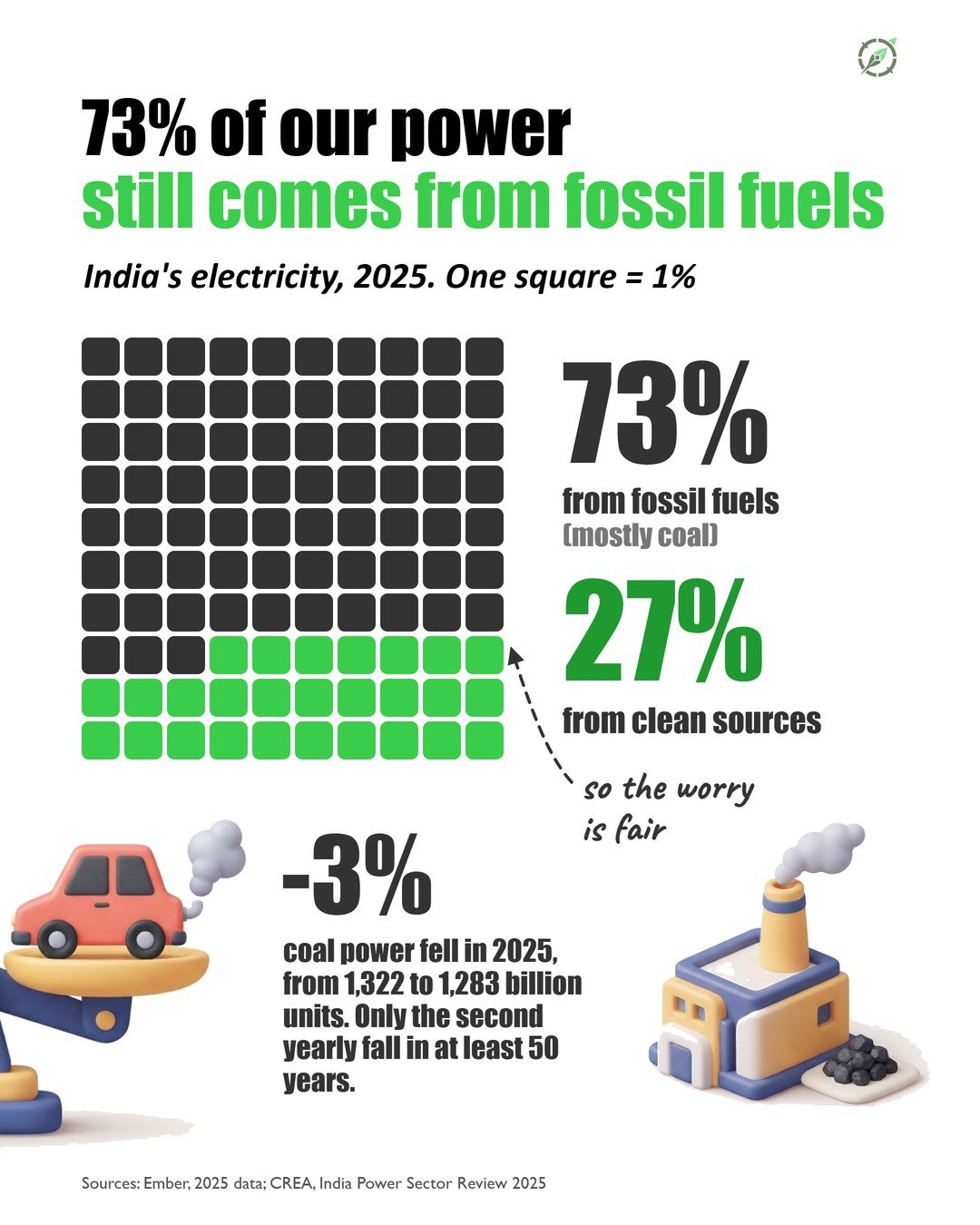
Yes, for now. In 2025, 73% of India's power came from fossil fuels and 27% from clean sources, says Ember.
There is one hopeful sign. Coal power fell 3% in 2025, from 1,322 to 1,283 billion units. It was only the second yearly fall in at least 50 years, says the Centre for Research on Energy and Clean Air (CREA).
Does an EV start dirtier?
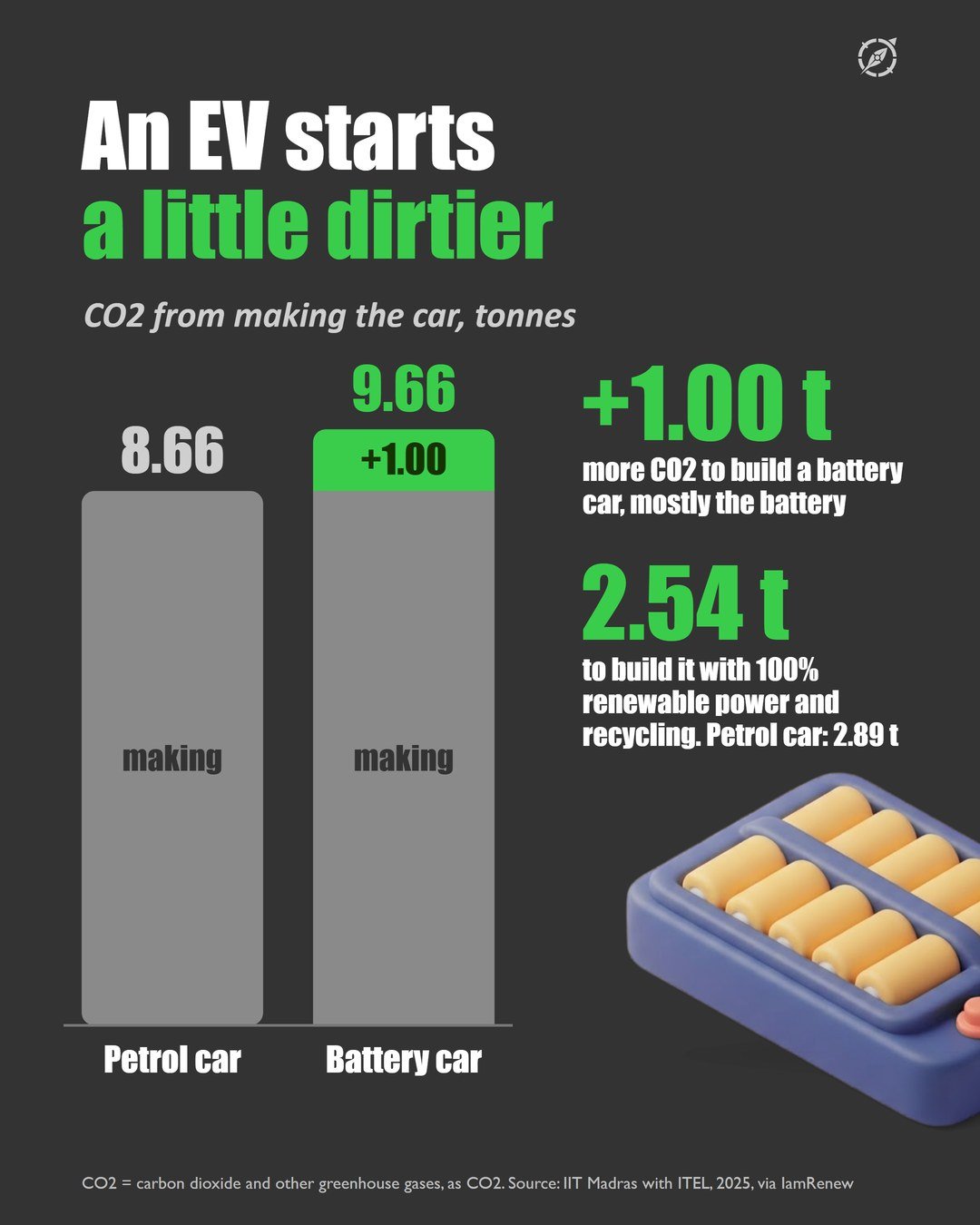
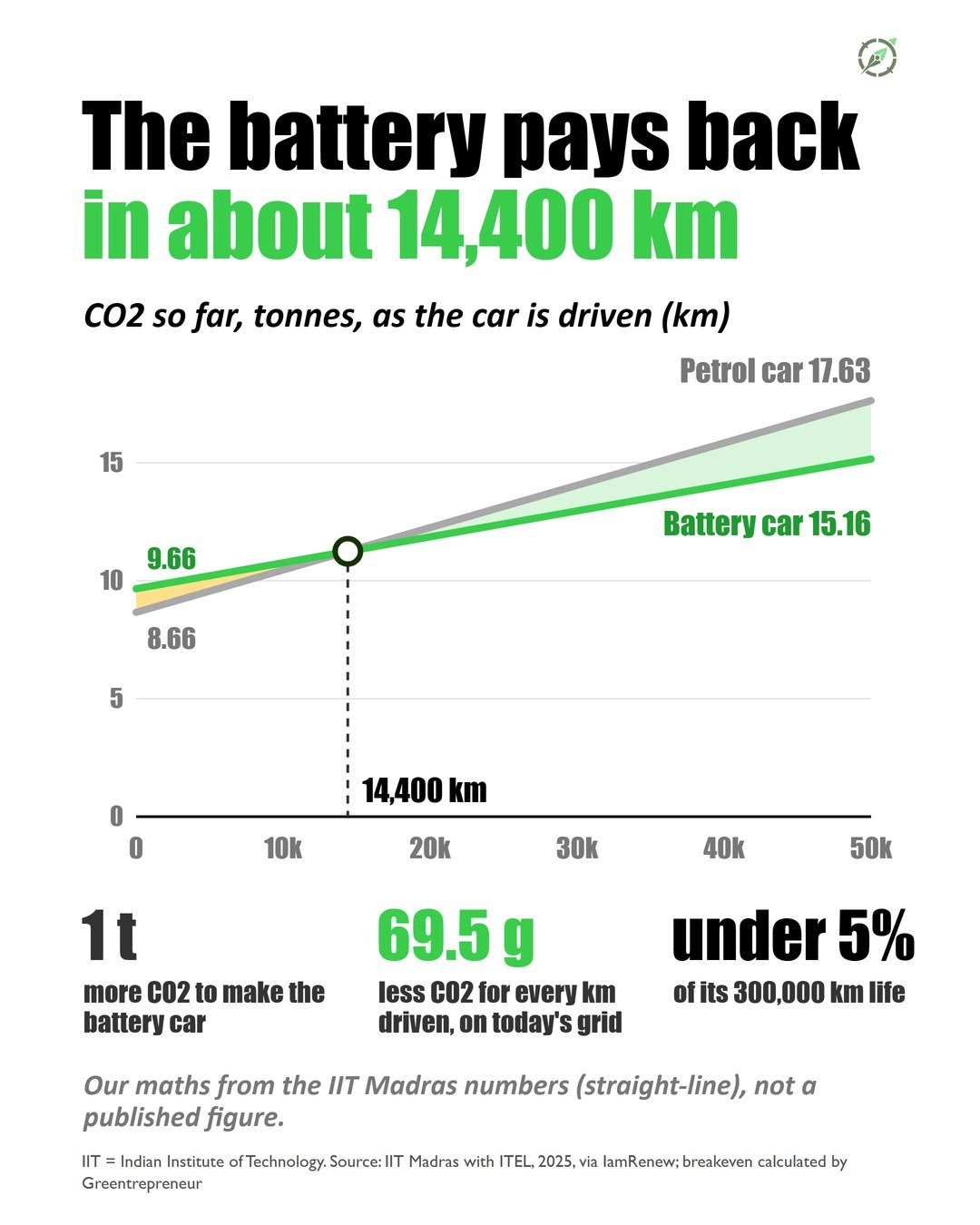
Yes. Making a battery car emits 9.66 tonnes of CO2. Making a petrol car emits 8.66. The extra tonne is mostly the battery.
With 100% renewable power and recycling, the battery car would take only 2.54 tonnes to build. The petrol car would still need 2.89.
Battery makers can shrink this gap. Cleaner power in the factory and recycled metals both cut that extra tonne.
So the factory is where the EV starts behind. The question is how fast it catches up.
What happens over the car's life?
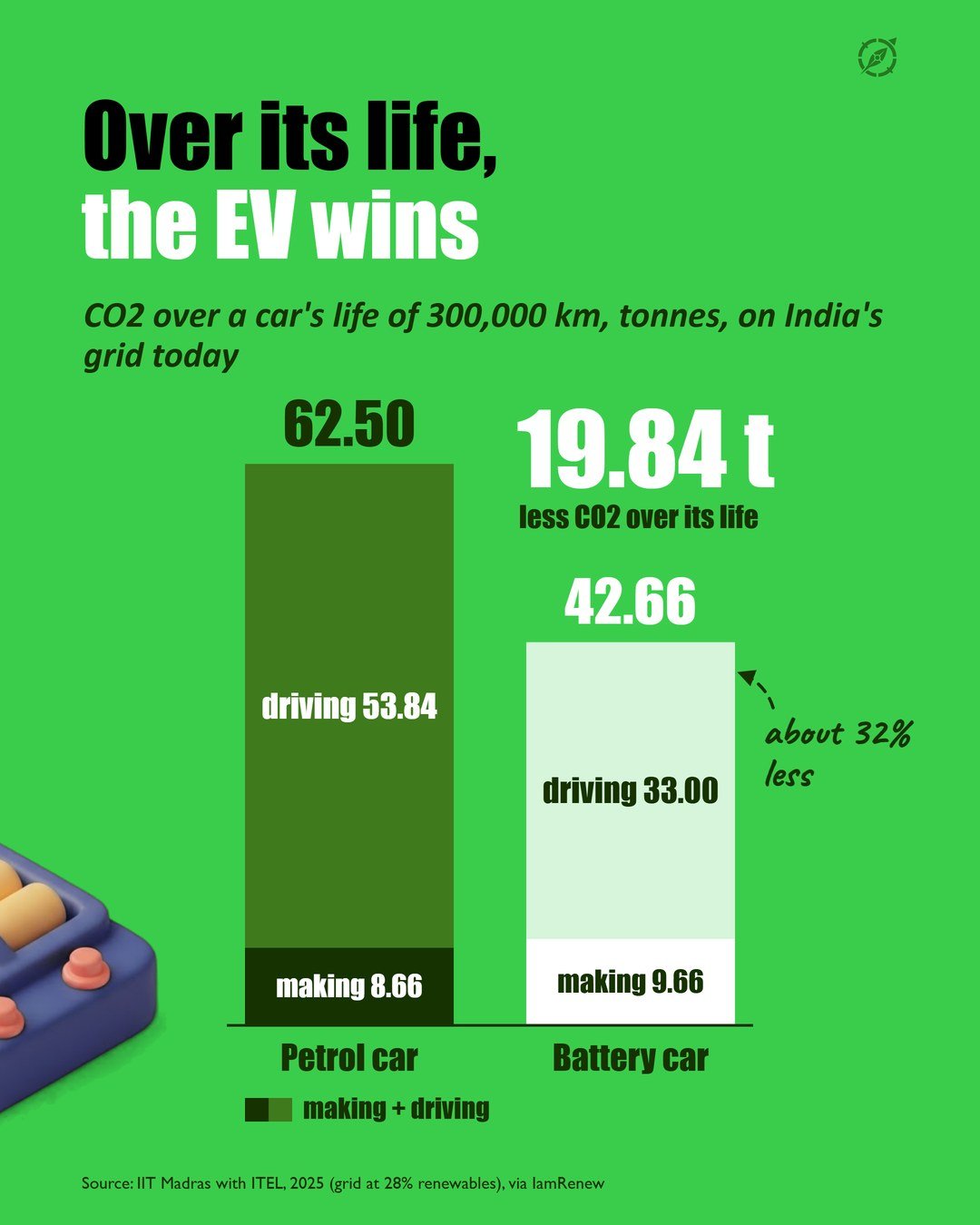
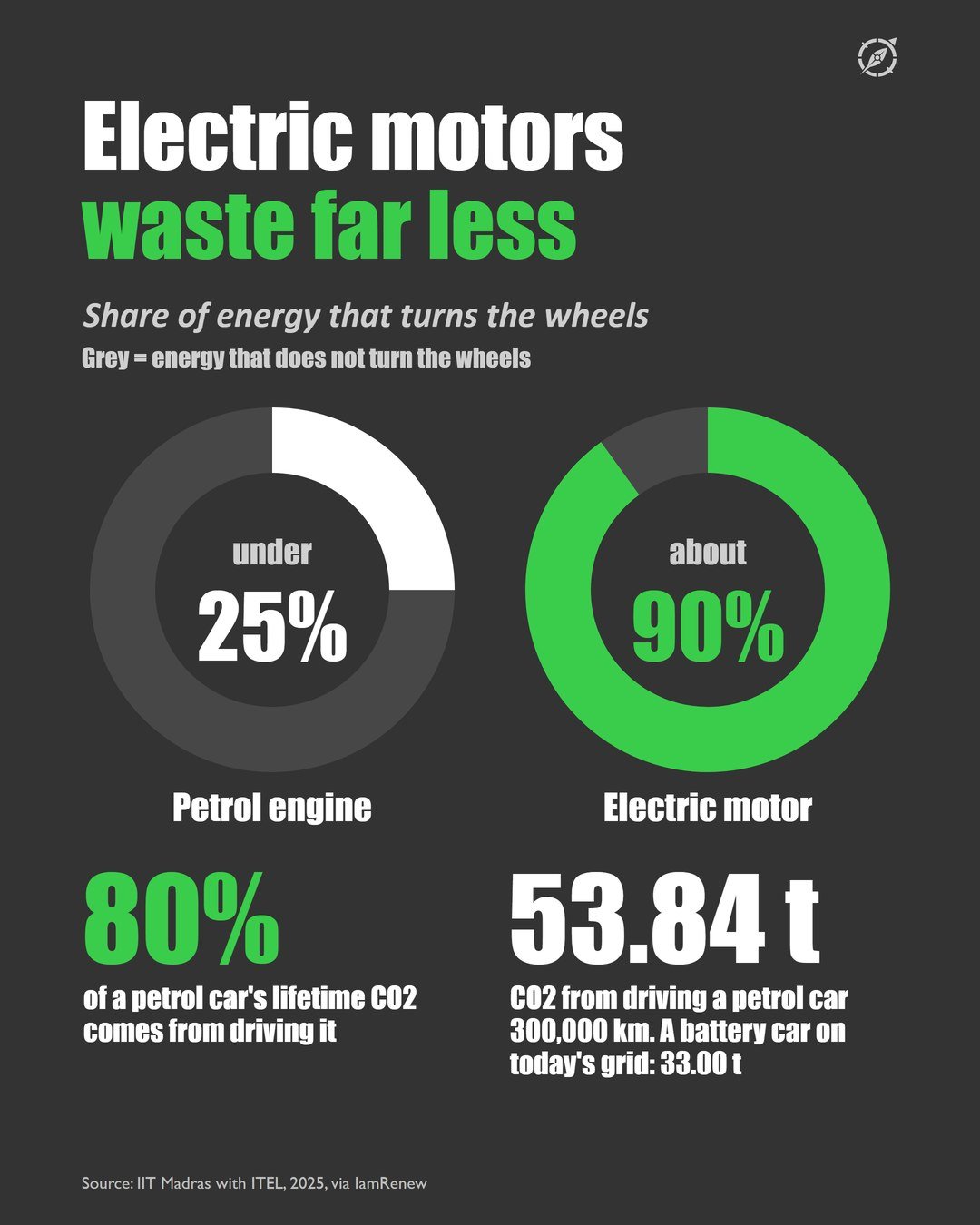
The study uses a life of 300,000 km on today's grid, which is 28% renewable. A petrol car adds 53.84 tonnes from driving, for 62.50 tonnes in all. A battery car adds 33.00 tonnes from driving, for 42.66 tonnes in all.
That is 19.84 tonnes less, or about 32%. Driving is where the gap opens: 80% of a petrol car's lifetime CO2 comes from driving it.
One note on distance. One news report says the study assumed a "lakh" kilometres, which is 100,000. The numbers only fit 300,000 km, so I use that.
The EV starts a tonne behind. Then it pulls ahead for good.
How soon does the EV catch up?
By my maths from the study's numbers, the battery car pays back its extra tonne in about 14,400 km. That is under 5% of the car's life. It is my straight-line calculation, not a figure the study published.
The reason is simple. On today's grid the EV emits about 69.5 grams less CO2 for every kilometre. And an electric motor turns about 90% of its energy into motion, while a petrol engine turns under 25%.
Even when the power comes from coal, the car wastes much less of it. In plain words, you need less energy to move the same car, so a dirty grid hurts less.
The story in 10 slides


Do other studies agree?
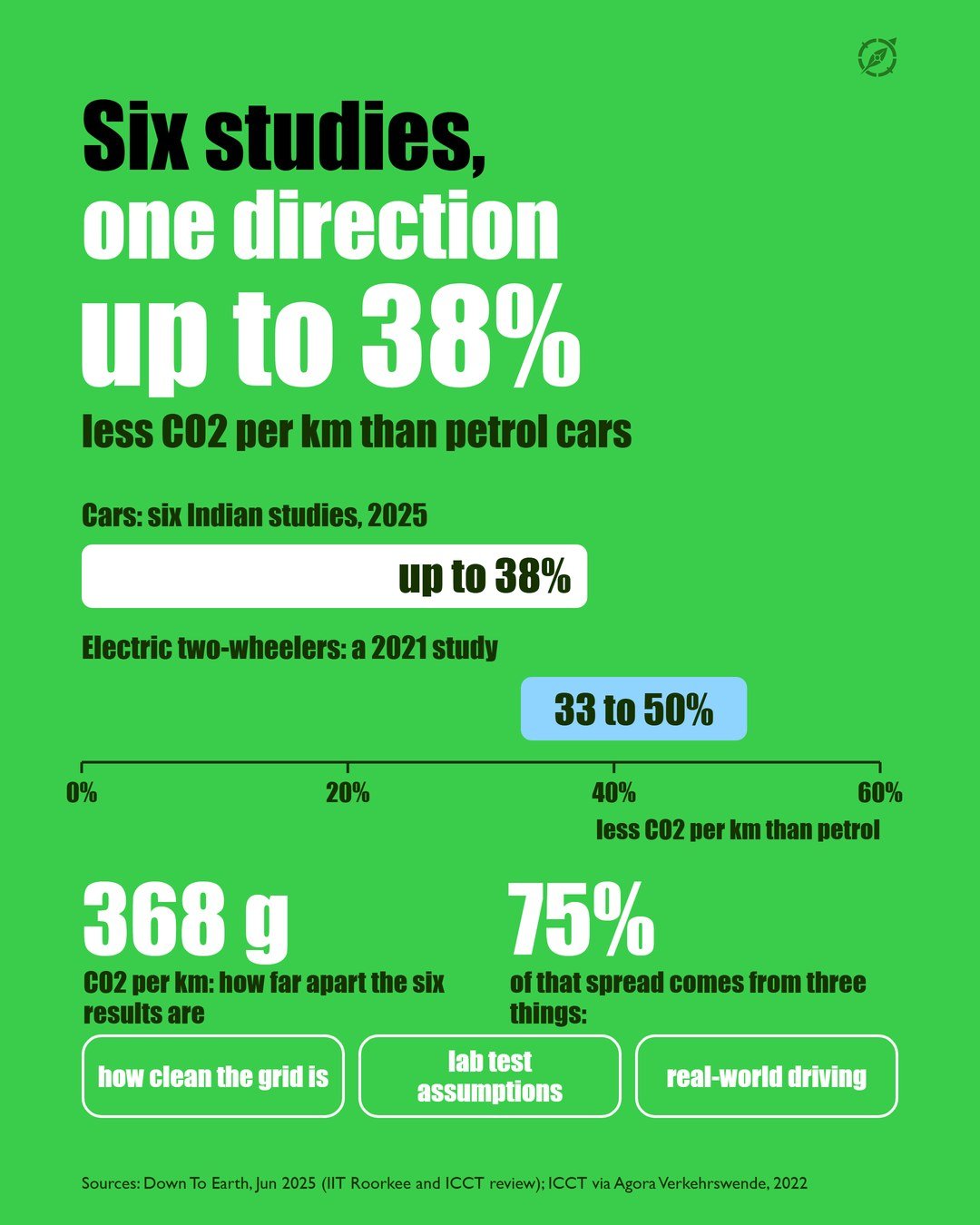
A June 2025 review by IIT Roorkee and the ICCT looked at six Indian studies of cars. They point the same way, with up to 38% less CO2 per km than petrol. So I read 38% as the best case and 32% as the central case.
Electric two-wheelers do better still. A 2021 ICCT study found 33% to 50% less than a new petrol bike.
The six studies differ by as much as 368 grams of CO2 per km. About 75% of that spread comes from three things: how clean the grid is, lab test assumptions and real-world driving. So treat any single percentage with care.
None of these studies says an EV is perfect. They say it is better, by a margin that depends on the grid. I did not find a study of a fully coal grid to quote. If coal came back, I expect the gap would narrow.
What if the grid gets cleaner?
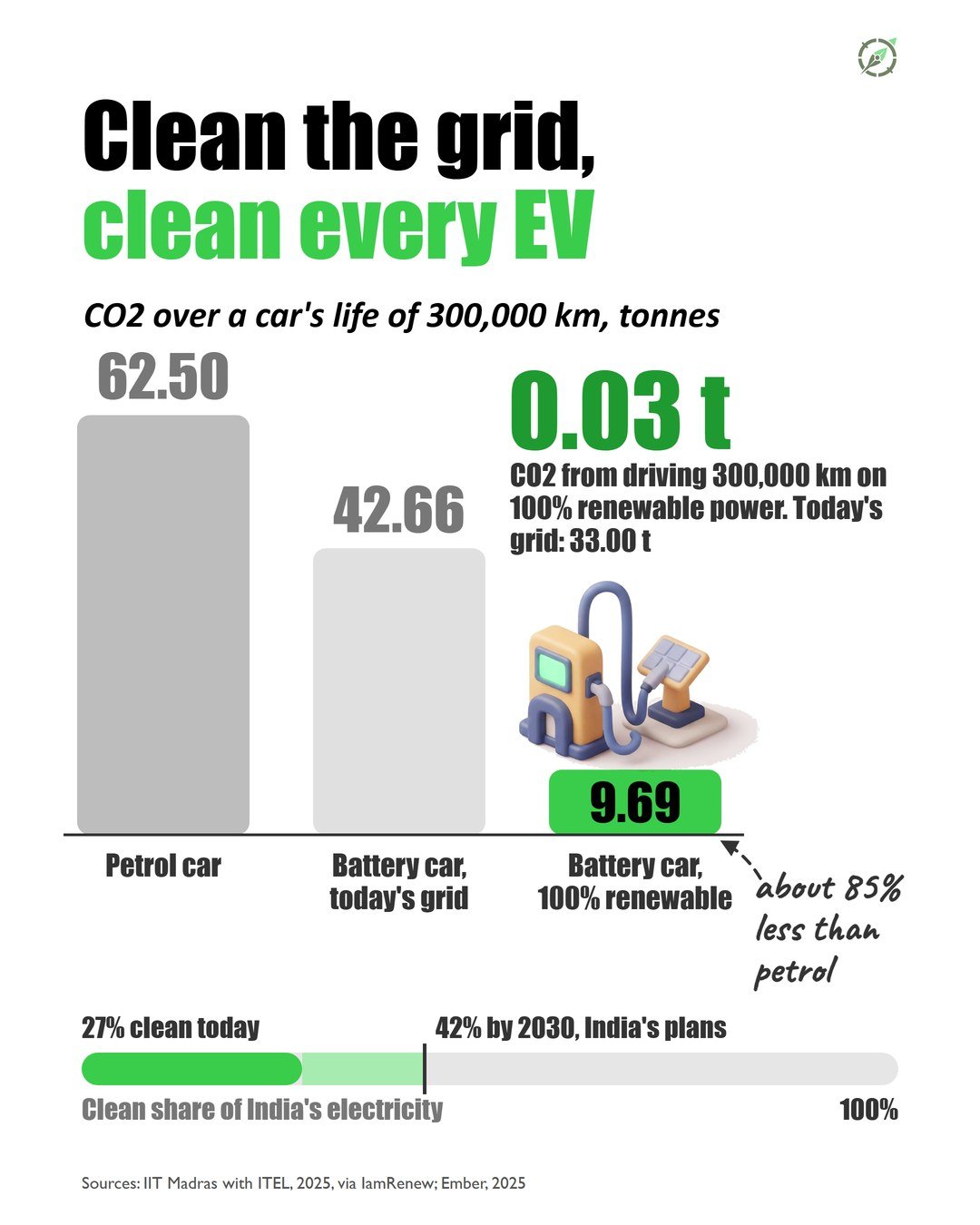
On 100% renewable power, the same car would emit 9.69 tonnes over its life. That is about 85% less than the petrol car's 62.50. Driving 300,000 km on clean power would add only 0.03 tonnes.
India's clean share is 27% today. Its plans point to 42% by 2030. Each step on that path makes every EV already on the road cleaner, without the owner doing anything.
That matters for a buyer. A petrol car's emissions per kilometre are fixed the day it leaves the showroom. An electric car's emissions per kilometre follow the grid. Over the years you own the car, the gap can only widen.
How a founder can help EVs get cleaner
- Sell clean power. An electric car's emissions per kilometre follow the grid.
- Add rooftop solar. On 100% renewable power, the same car would emit about 85% less than the petrol car.
- Ride the grid. India's clean share is 27% today, and its plans point to 42% by 2030.
- Do not forget two-wheelers. A 2021 ICCT study found 33% to 50% less CO2 than a new petrol bike.
Clean power is the one thing the study says matters most.
I think an EV keeps getting cleaner as the grid does.
An EV keeps getting cleaner, as long as our grid keeps getting greener.
Questions
Are electric cars cleaner than petrol cars in India?
Yes, over their life. The 2025 IIT Madras study found about 32% less CO2 for a battery car on India's current grid.
Does making an EV battery cause more emissions?
Yes. A battery car emits about 1 tonne more CO2 to build than a petrol car, mostly from the battery. That extra tonne is paid back in about 14,400 km, by my calculation.
What if India's grid were fully renewable?
The same EV would emit about 85% less than a petrol car over its life, says the study.
Sources
- IIT Madras study confirms electric vehicles as vital for deep decarbonization, IamRenew (2025)
- BEVs outperform petrol cars on lifecycle emissions, including manufacturing, IANS (2025)
- Study reveals electric vehicles in India emit up to 38% less CO2 than petrol cars, Down To Earth (2025)
- India, Ember (2025 data)
- India Power Sector Review 2025, CREA (2026)
Show the other 1 sources
Corrections: none so far. Found a mistake? Email me and I will fix it and note it here.