

Data centres are booming. Are they green?
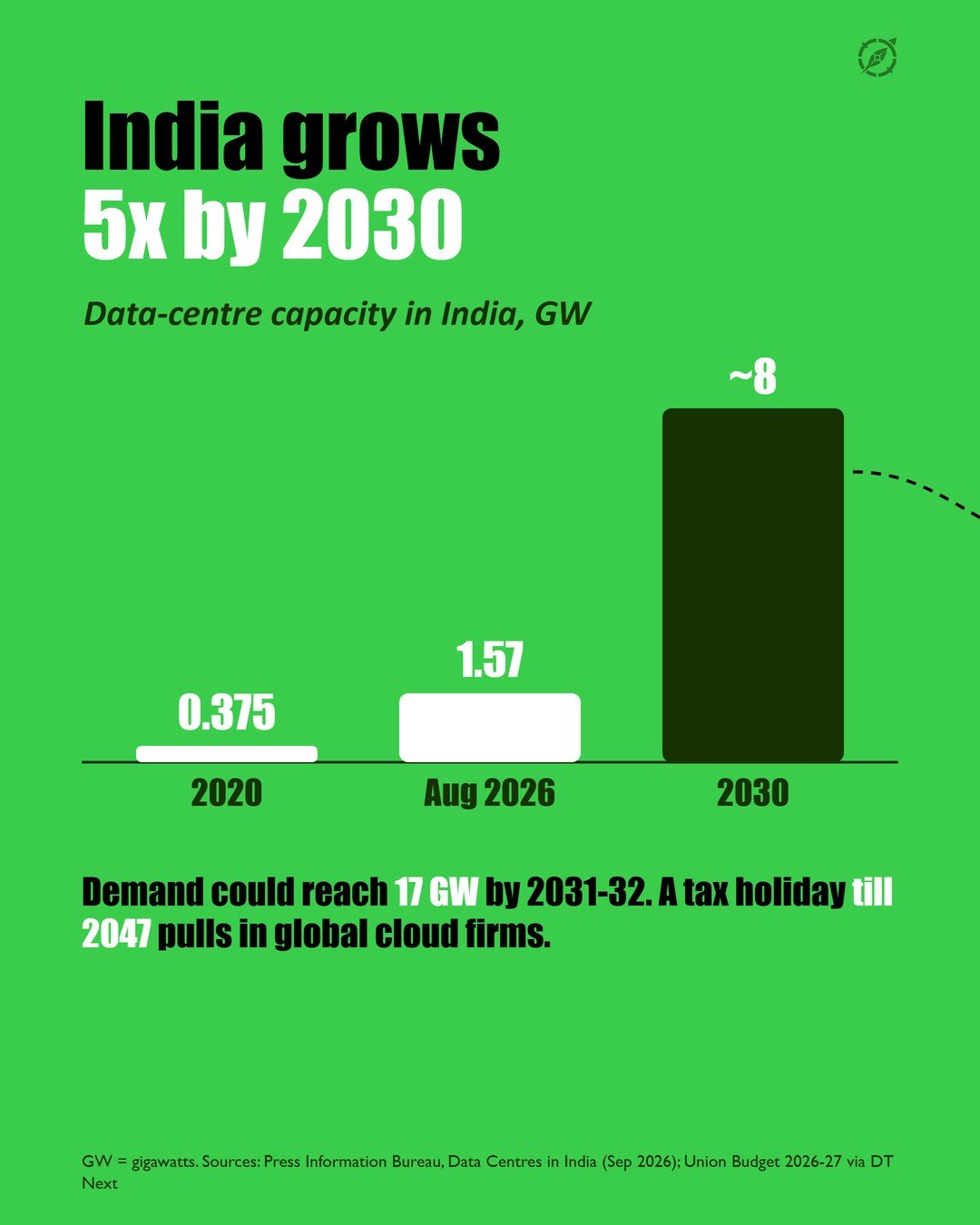
India's data-centre capacity grew from 375 MW in 2020 to 1.57 GW today. Whether that growth is green depends on three things: power, water and waste.
Every search, video and AI answer runs in a building somewhere. Those buildings now use a growing share of the world's electricity, and India is one of the fastest-growing places for them.
Key numbers
Sources: International Energy Agency via Enlit (2026); Uptime Institute (2026); Google 2026 Environmental Report; CEEW (2026); Press Information Bureau (Sep 2026).
How fast is the demand growing?
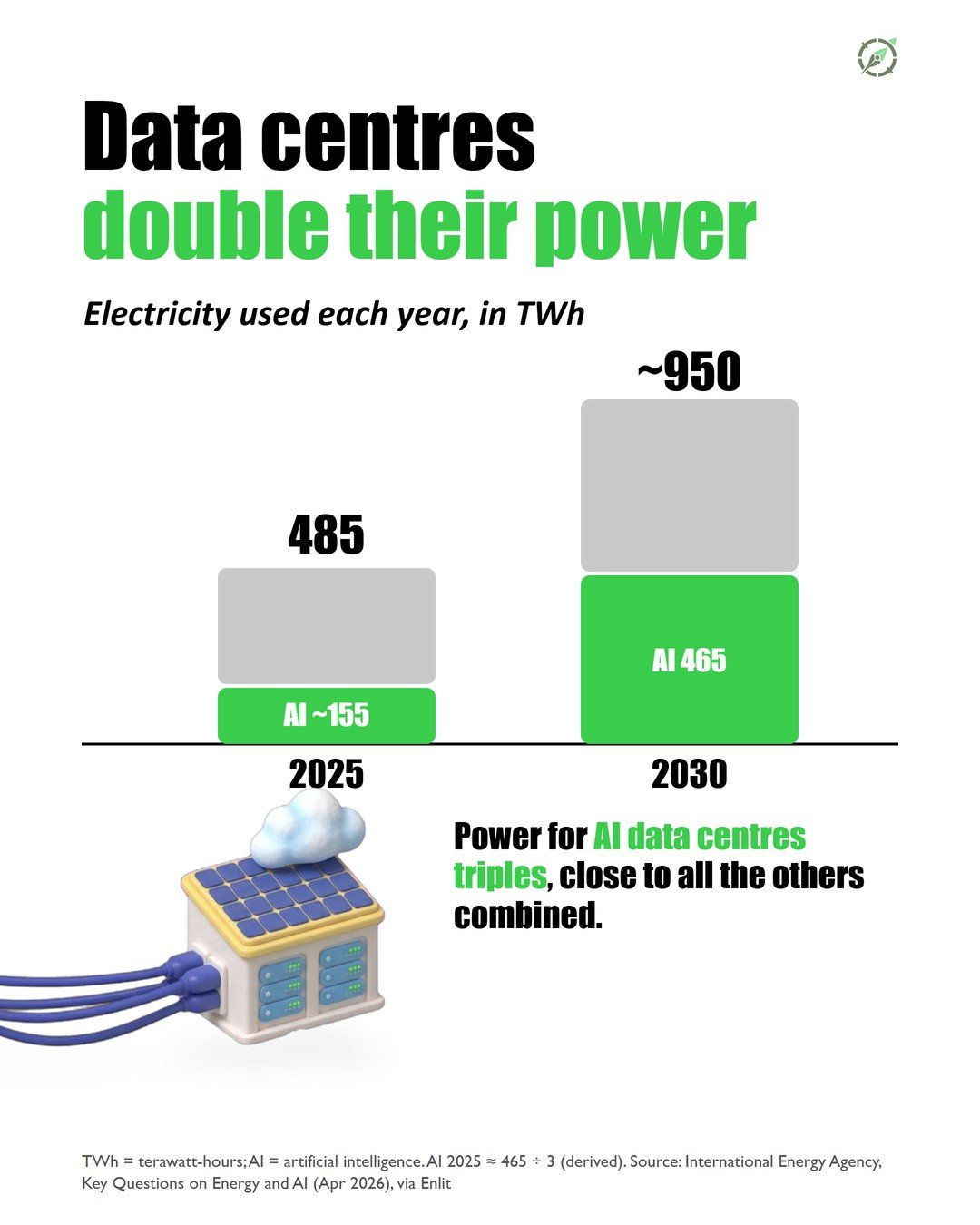
The IEA expects world data-centre power use to rise from 485 TWh in 2025 to about 950 TWh in 2030. That is roughly 3% of world demand today, and the share is rising.
AI-focused data centres are the fastest part. Their power use is expected to triple to 465 TWh by 2030, close to all the conventional centres combined.
India's capacity went from 375 MW in 2020 to 1.57 GW in August 2026. The government expects about 8 GW by 2030. The Central Electricity Authority puts demand at 17 GW by 2031-32.
Investment is following. Projects underway total about ₹6.7 lakh Cr, and announced projects add another ₹8.7 lakh Cr.
Where does the power come from?
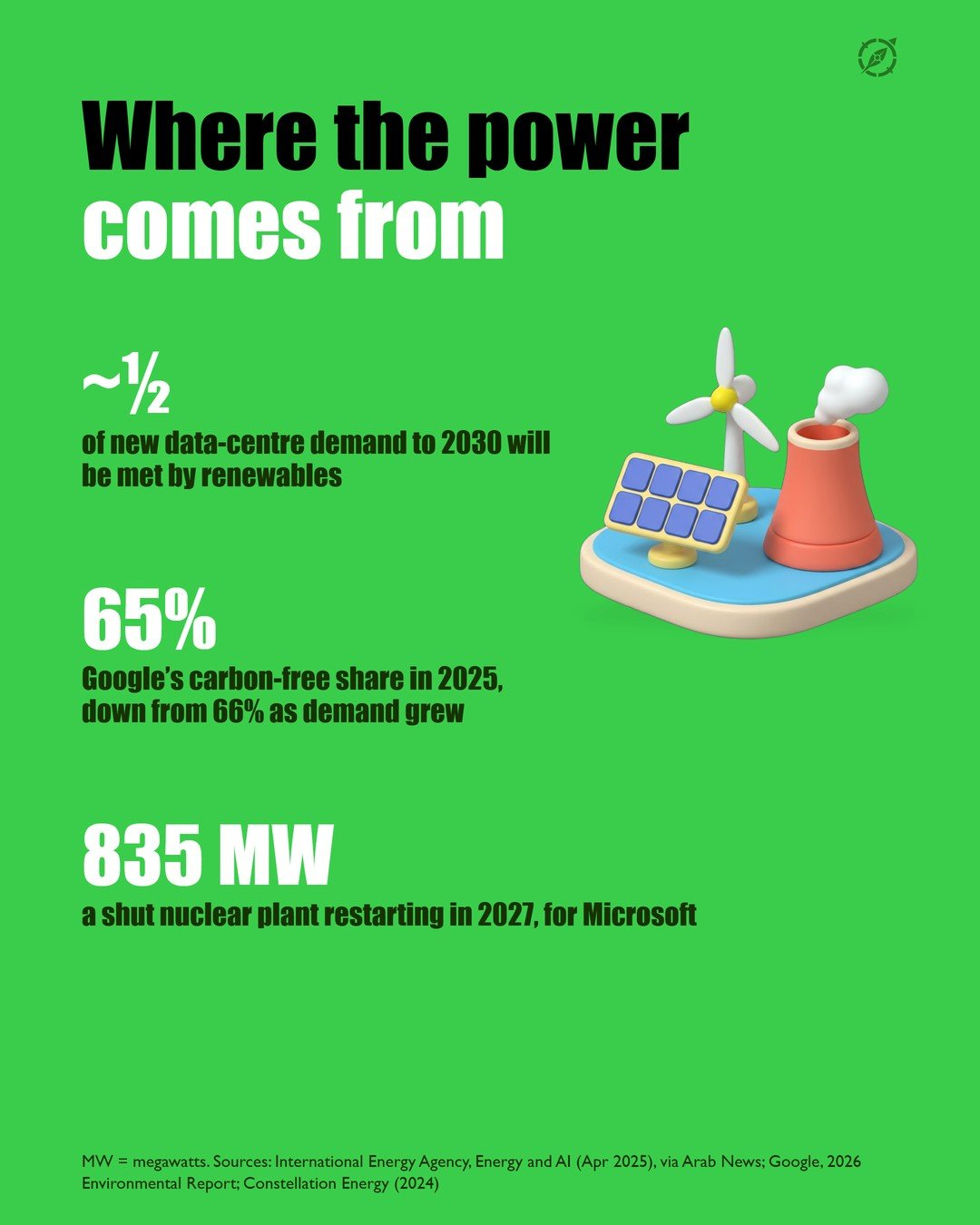
About half of the new data-centre demand to 2030 can be met by renewables, according to the IEA. Gas and nuclear each add about 175 TWh.
Developers say about 80% of the renewable supply they need is feasible in India, if they mix sites. The clean supply is possible, but it needs planning.
Even the leaders are struggling to keep up. Google's carbon-free share slipped to 65% in 2025, from 66% in 2024, even as it expanded.
Some firms are turning to nuclear. Constellation is restarting the Three Mile Island unit 1 as the Crane Clean Energy Center, with 835 MW for Microsoft under a 20-year deal, with power expected in 2027.
Even the leaders slipped while demand grew. Clean power has to keep up with the building.
How much water does cooling drink?
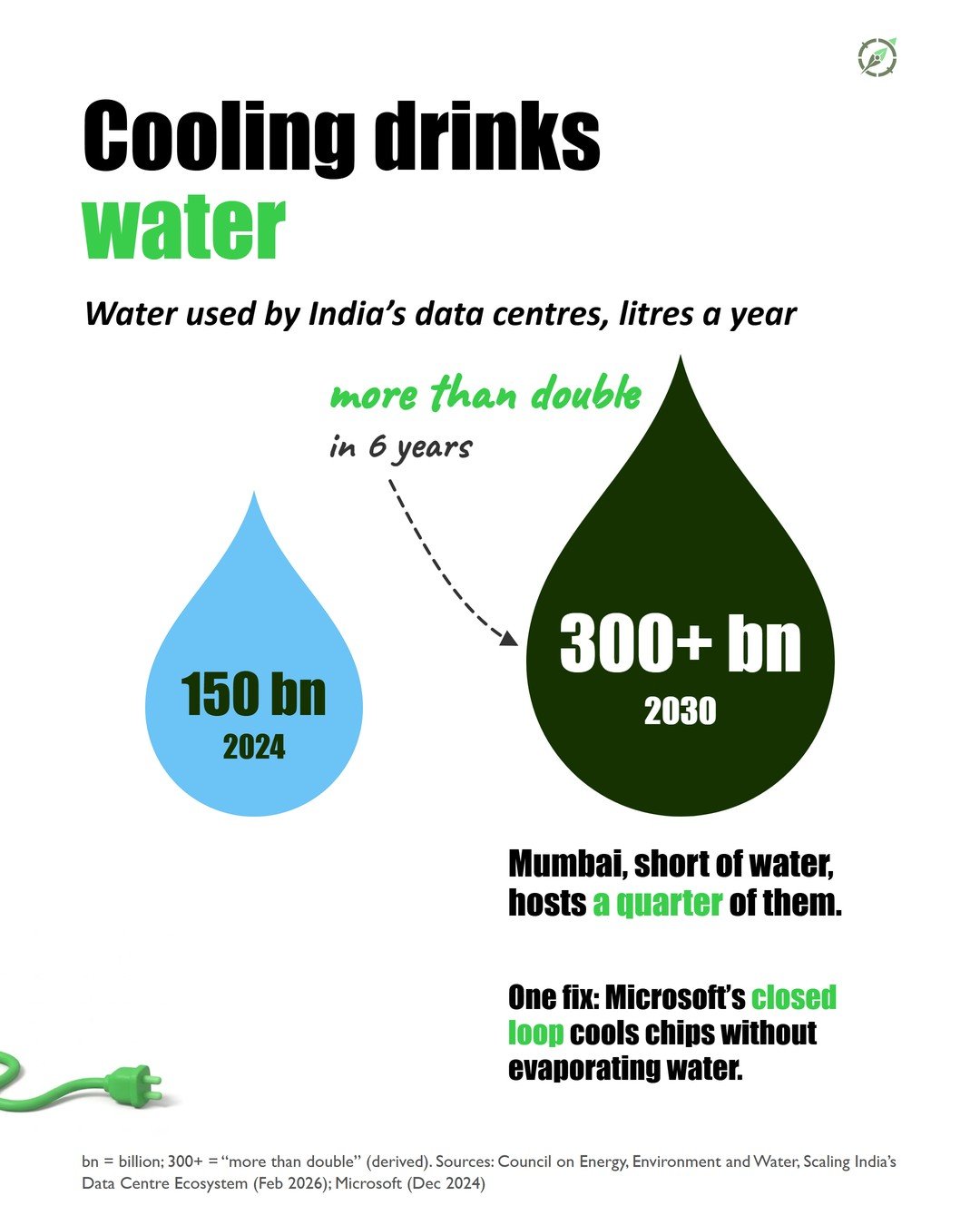
India's data centres used about 150 billion litres of water in 2024. Use is set to more than double by 2030.
Most of the capacity sits in the driest cities. Mumbai, Chennai, Delhi-NCR and Bengaluru hold nearly 90% of it. Mumbai alone has nearly a quarter of India's roughly 271 data centres.
Some designs avoid evaporation altogether. Microsoft says its newer designs use closed-loop chip cooling, with zero evaporation. Its Fairwater AI campus is said to use about as much water a year as a restaurant.
How much power is wasted?
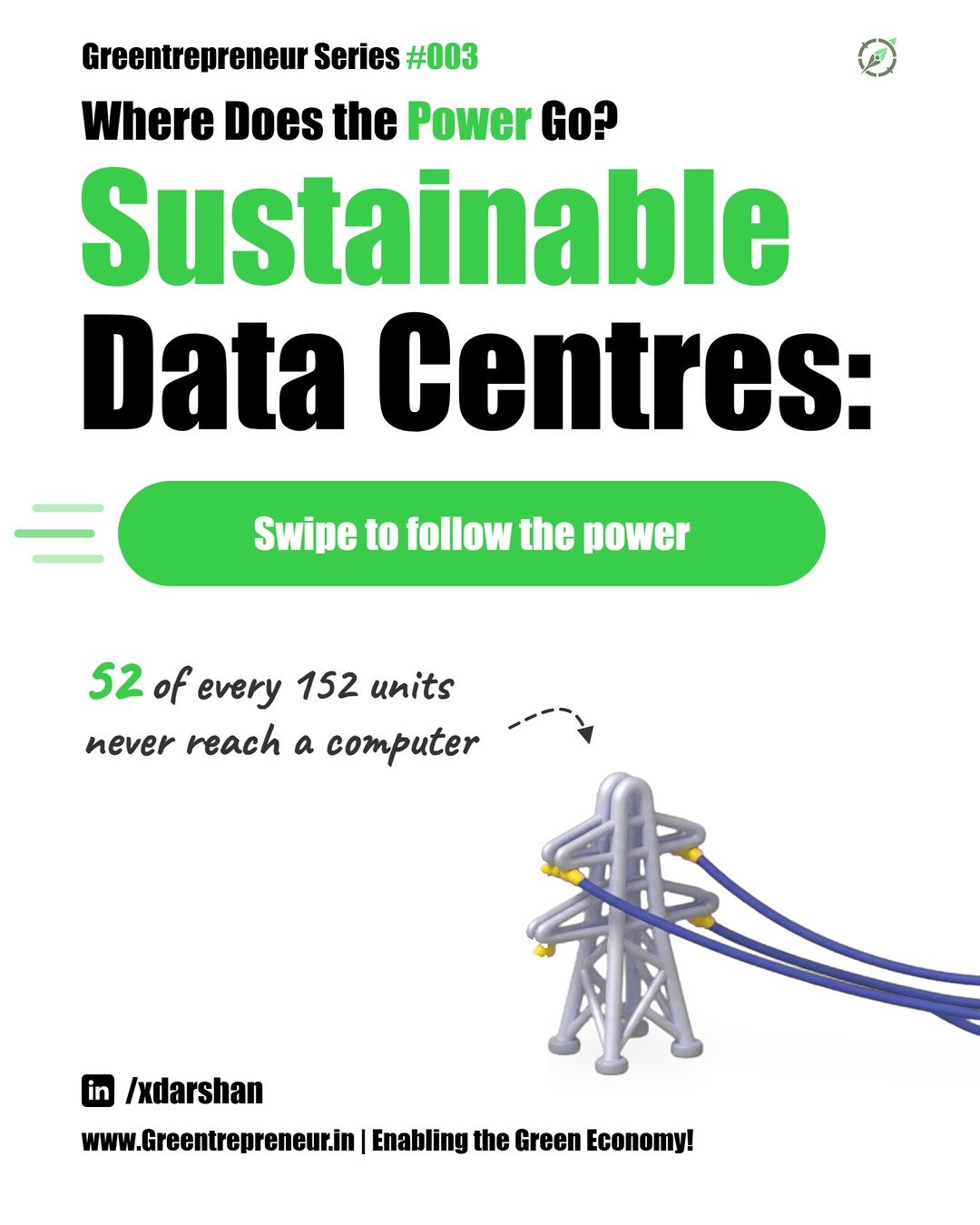
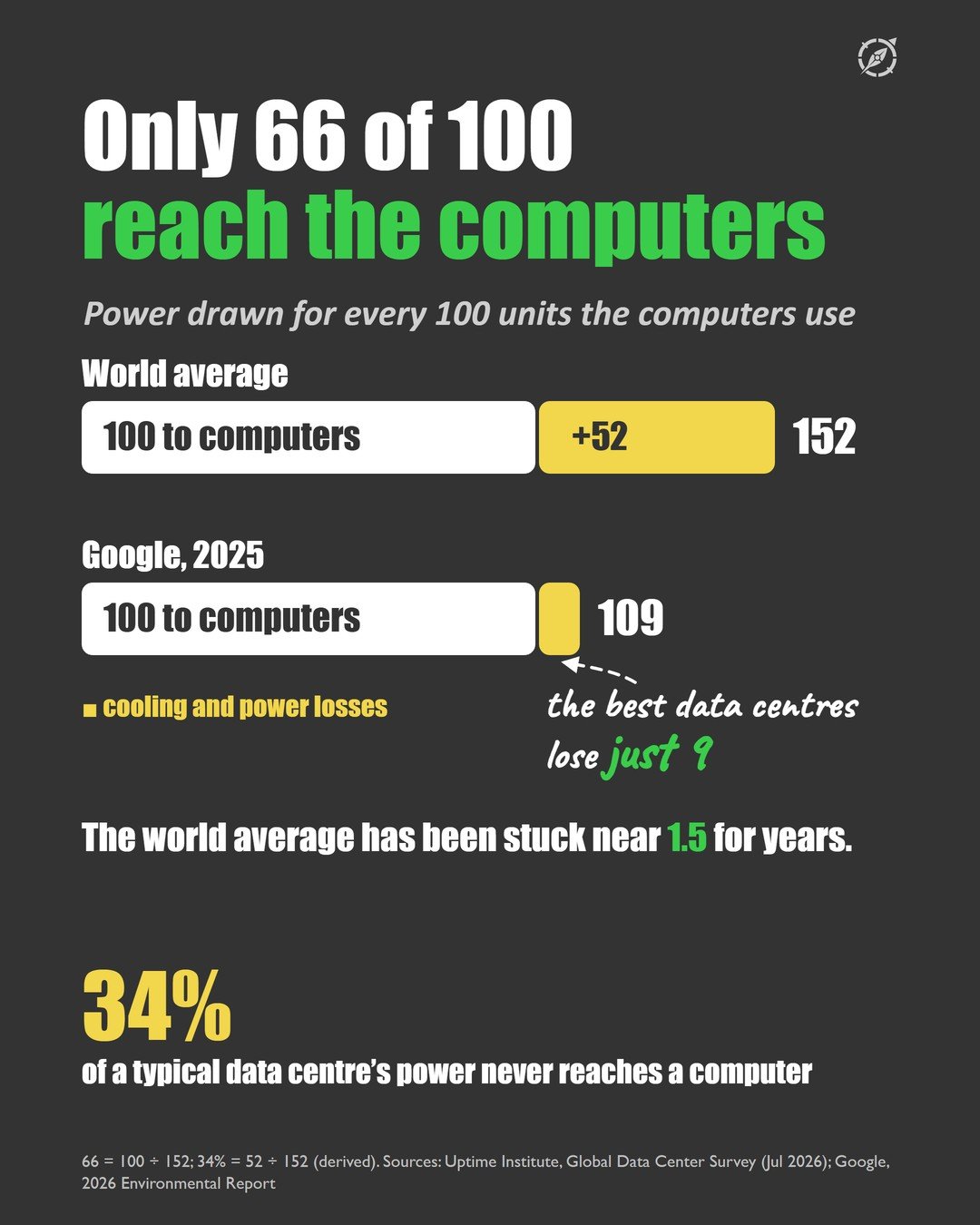
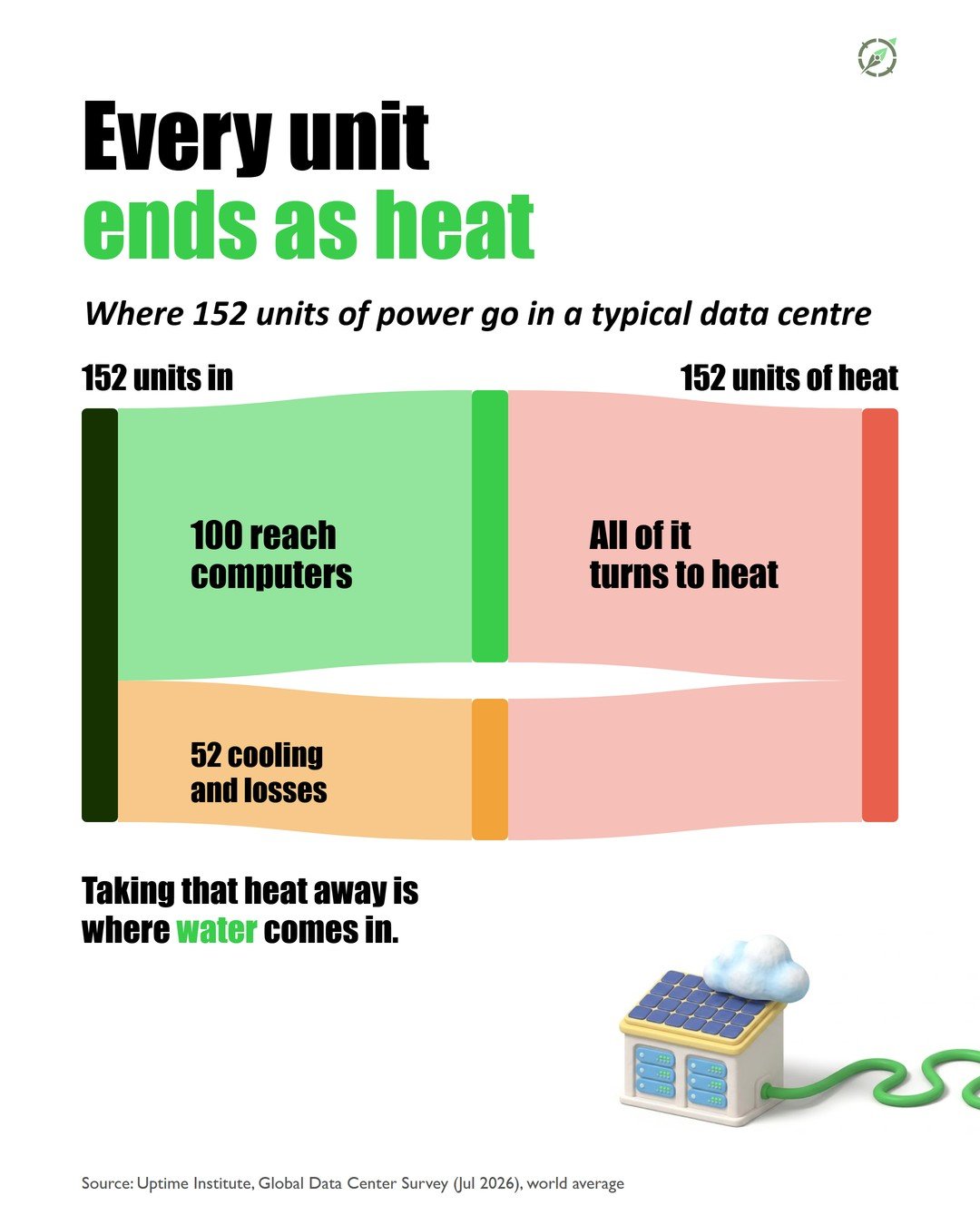
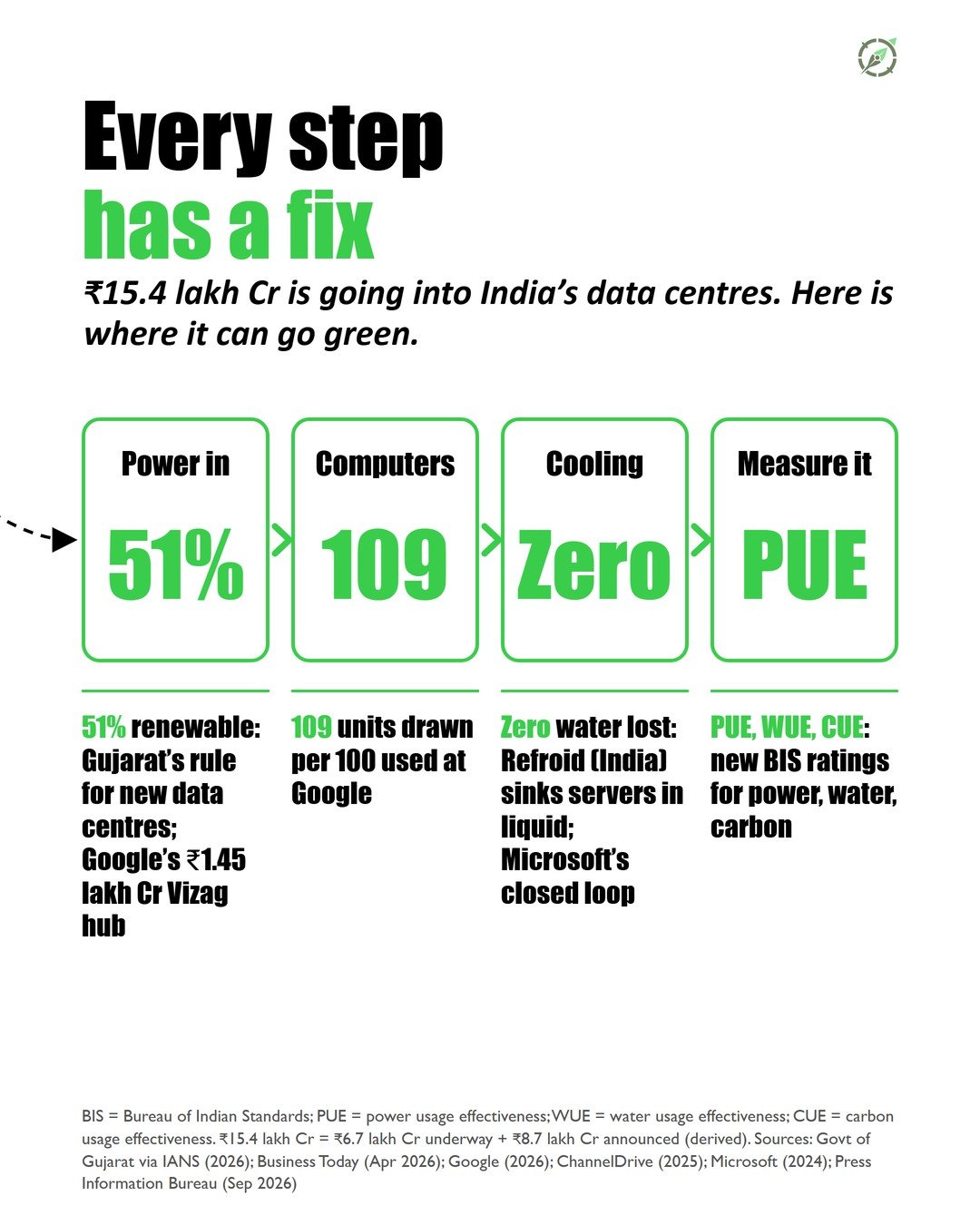
A common measure is PUE, power usage effectiveness. A PUE of 1.52, the world average in Uptime's 2026 survey, means 52 extra units of power go to cooling and losses for every 100 units that reach the computers.
Google's fleet ran at 1.09 in 2025, only 9 extra units per 100. That is the gap between average practice and a leader.
Waste heat is the other loss. In Helsinki, Microsoft's data-centre heat is set to supply about 40% of Fortum's district heating. The EU requires data centres above 1 MW to report energy and water use and assess heat reuse.
The story in 10 slides
What is India doing?
The Union Budget offers a tax holiday to foreign cloud firms that serve global customers from Indian data centres, until 2047.
Gujarat's 2026-29 policy asks for at least 51% renewable power, with a 7.5 GW green AI target and ₹6 lakh Cr of investment.
The national standards now measure power, water and carbon efficiency together. These are called PUE, WUE and CUE, and they work like a mileage rating for data centres.
Who is building the green version?
Google's Vizag AI hub, with AdaniConneX, is planned at 1 GW, with renewable-linked power from 2026 to 2030. It is an investment of about USD 15 billion.
Startups are working on the heat and water problem. Refroid makes liquid immersion cooling for data centres. Google's Project Suncatcher is a longer bet: solar-powered AI chips in orbit, with prototypes planned for early 2027.
What a green data centre needs
- Clean power. The IEA says about half of new demand to 2030 can be met by renewables, and Gujarat's policy asks for at least 51% renewable power.
- Low water use. Closed-loop chip cooling uses zero evaporation, which matters when Mumbai, Chennai, Delhi-NCR and Bengaluru hold nearly 90% of the capacity.
- Low waste. Google's fleet ran at a PUE of 1.09 in 2025, against a world average of 1.52.
- Heat reuse. In Helsinki, Microsoft's data-centre heat is set to supply about 40% of Fortum's district heating.
The national standards now measure power, water and carbon efficiency together, as PUE, WUE and CUE.
Google's Project Suncatcher is a longer bet: solar-powered AI chips in orbit, with prototypes planned for early 2027.
Power and water are the two questions to ask about any new data centre.
Questions
How fast is India's data-centre capacity growing?
It went from 375 MW in 2020 to 1.57 GW in August 2026. The government expects about 8 GW by 2030.
What does PUE mean?
PUE is power usage effectiveness. A PUE of 1.52 means 52 extra units of power go to cooling and losses for every 100 units that reach the computers.
Is clean power keeping up with demand?
Not always. Google's carbon-free share slipped to 65% in 2025, from 66% in 2024, even as it expanded.
Sources
- PIB backgrounder on data centres (Sep 2026)
- CEEW, Scaling India's Data Centre Ecosystem (Feb 2026)
- Uptime Institute Global Data Center Survey (Jul 2026)
- IEA, Key Questions on Energy and AI, via Enlit (Apr 2026)
- IEA, Energy and AI, via Arab News (2025)
Show the other 11 sources
- CBRE on India data-centre capacity, via IANS (Apr 2026)
- Constellation, Crane Clean Energy Center
- Google 2026 Environmental Report
- Microsoft, zero-water cooling designs (2024)
- Union Budget 2026-27 tax holiday, DT Next (Feb 2026)
- Gujarat Data Centre Policy, via IANS (Aug 2026)
- Google Vizag AI data centre, Business Today (Apr 2026)
- Refroid immersion cooling, ChannelDrive (2025)
- Google Research, Project Suncatcher (Nov 2025)
- Fortum, heat pump plant at Microsoft's Kirkkonummi site
- EU Energy Efficiency Directive and data centres, Covington (2025)
Corrections: none so far. Found a mistake? Email me and I will fix it and note it here.