

Why India's green bonds are hard to sell
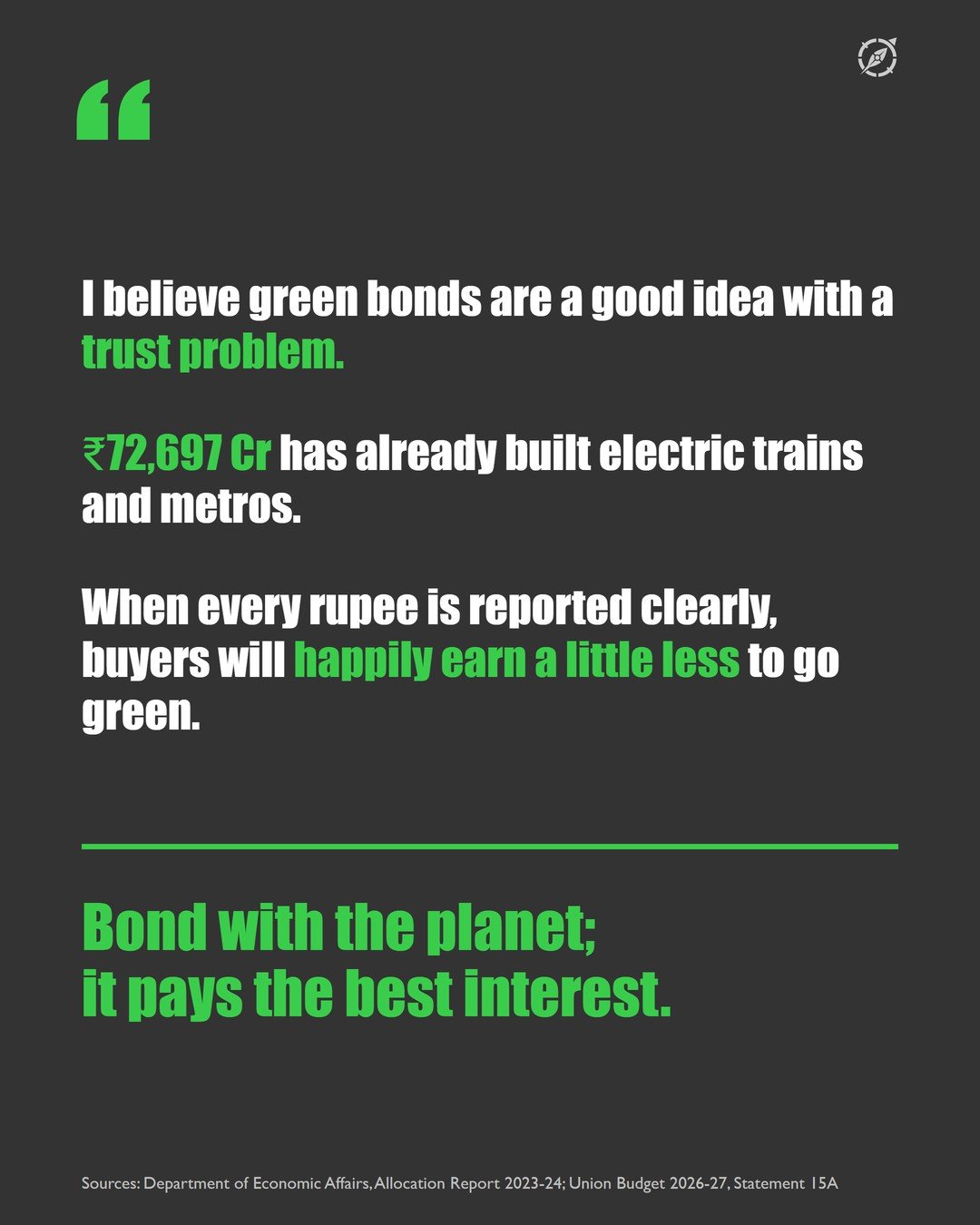
India has raised ₹72,697 Cr through green bonds since 2023. Buyers still will not accept a lower return just because the money is labelled green.
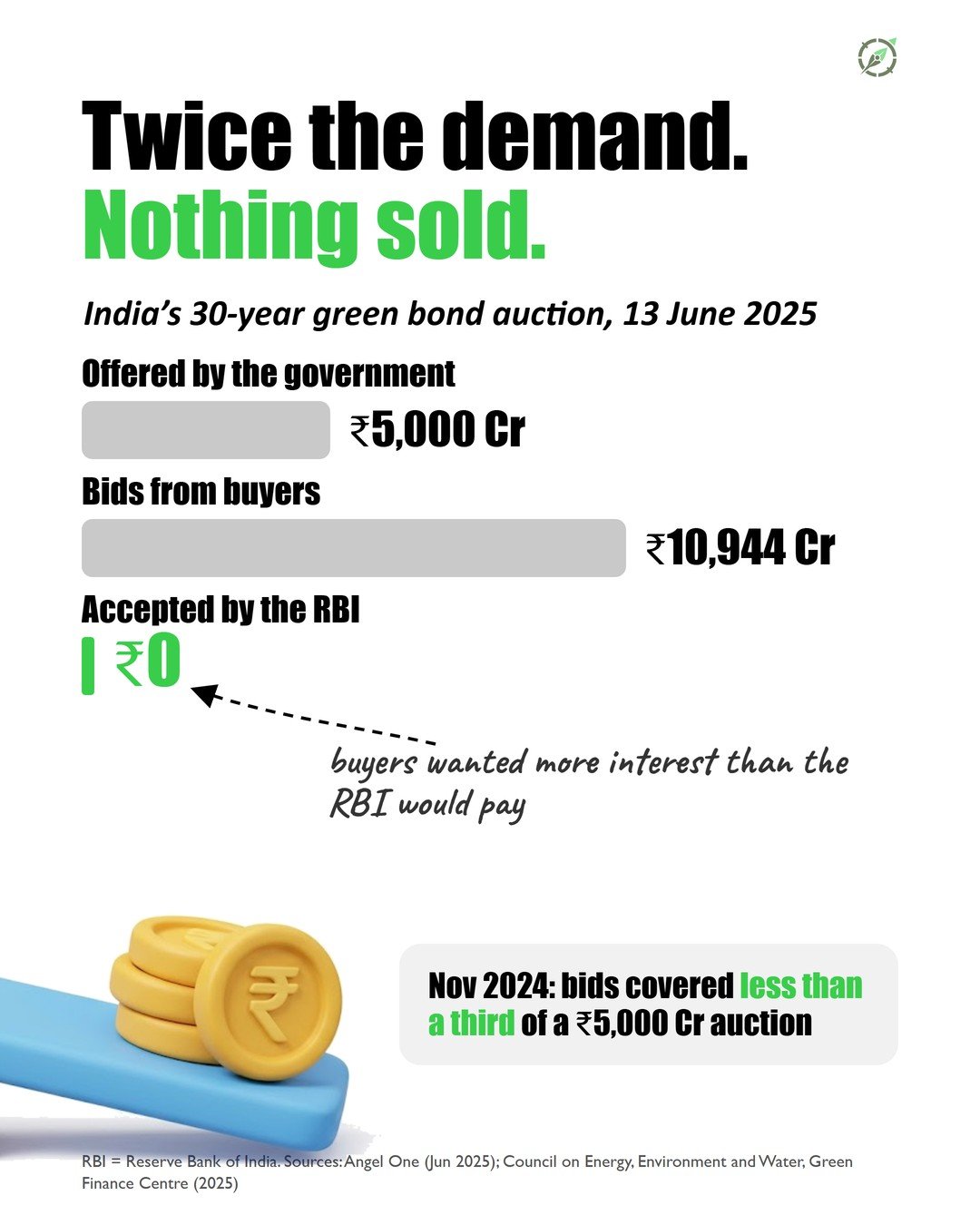
On 13 June 2025, the Reserve Bank of India turned down every bid for a ₹5,000 Cr green bond. The bids were worth ₹10,944 Cr. Buyers wanted more interest than the RBI would pay.
That auction is a good place to start. It shows that a green label is not enough to make a bond sell.
Key numbers
Sources: Angel One (Jun 2025); IEEFA (2025); Department of Economic Affairs; Union Budget 2026-27; Climate Bonds Initiative (2026); S&P Global via IANS (2026). ₹ at ₹96.4 per dollar.
What is a green bond?
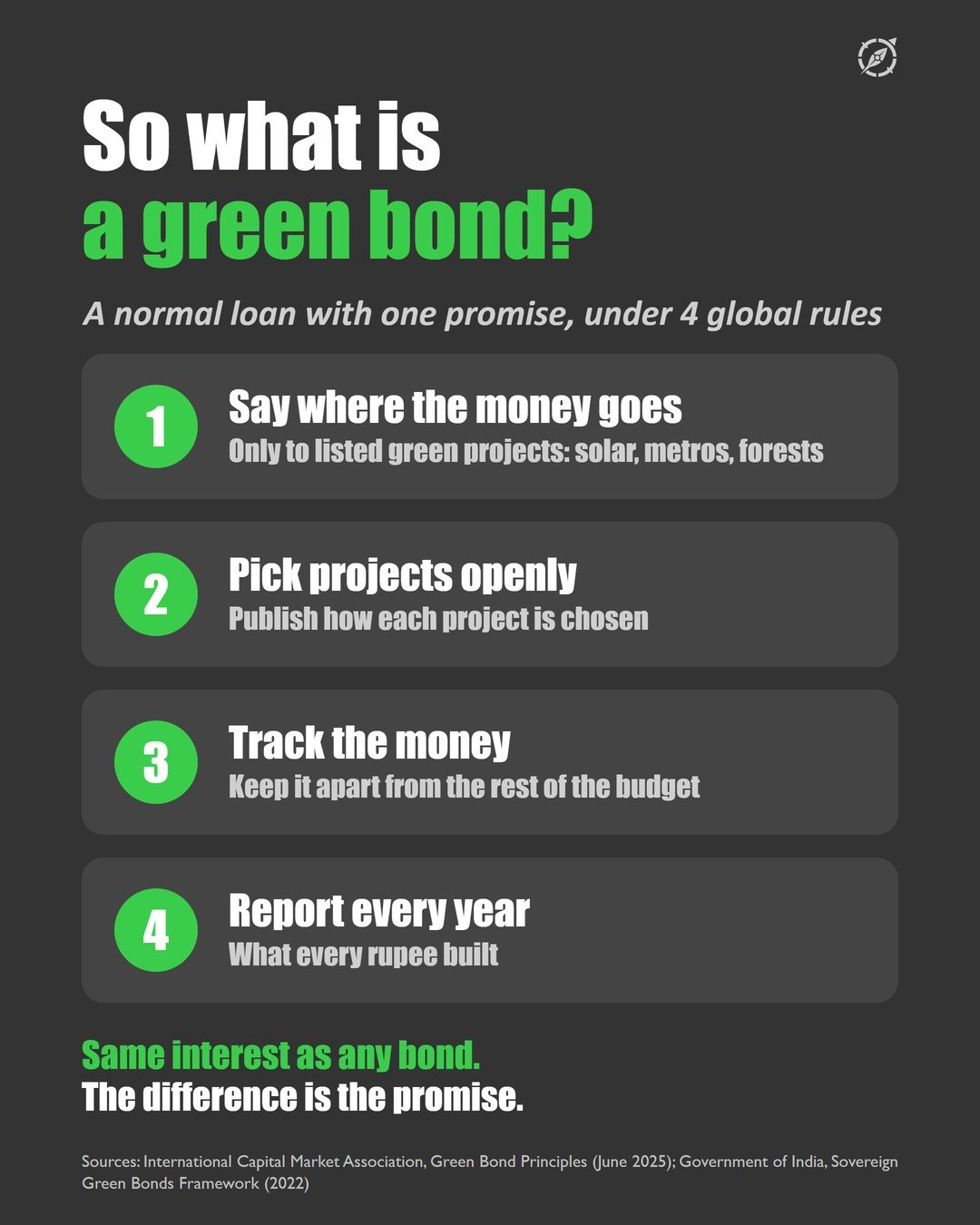
A green bond is an ordinary government bond with one promise. The money can fund only listed green projects. The interest is the same as any other bond.
India's framework lists 9 kinds of eligible projects, from renewables and clean transport to forests. It bans fossil fuels, nuclear power and big hydro over 25 MW.
The global rules are simpler. The ICMA principles ask issuers to say where the money goes, how projects are chosen, how the money is tracked, and to report every year. Those four steps are the backbone of green bonds worldwide.
India's framework was set in 2022, and it is still in force. It is the rulebook for every sovereign green bond sold since.
How much has India raised?
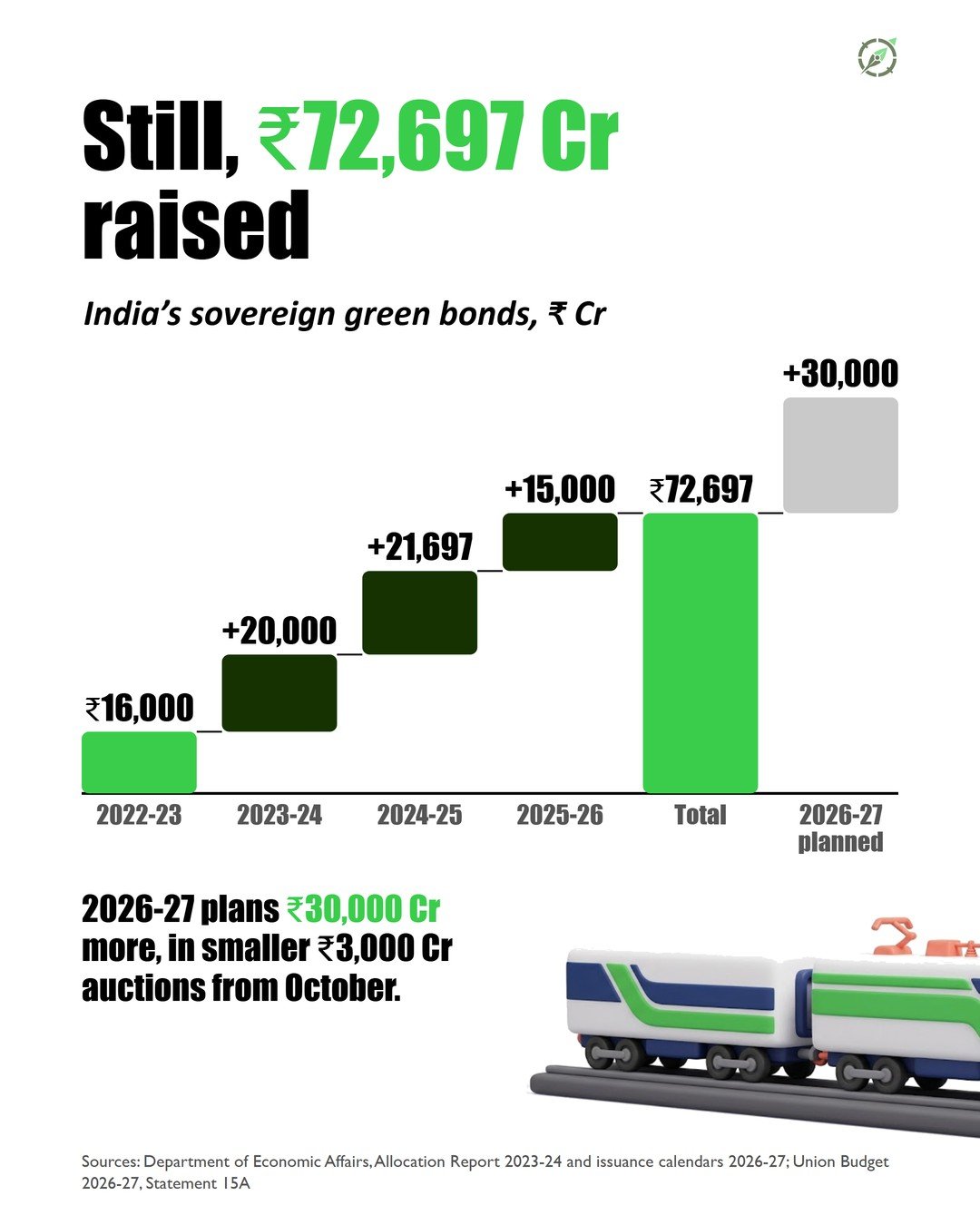
In four years the government raised ₹72,697 Cr. The sovereign programme started in January 2023, and the pace has moved up and down since.
It raised less in FY26, ₹15,000 Cr, down from ₹21,697 Cr the year before. The government also spent more on eligible schemes than it raised from the bonds.
The plan for 2026-27 is ₹30,000 Cr. Three ₹5,000 Cr auctions were planned for April to August 2026. The remaining ₹15,000 Cr is set for October 2026 to March 2027, in ₹3,000 Cr tranches of 30-year bonds.
The label is working on the balance sheet. It is not yet working on the price.
Where did the money go?
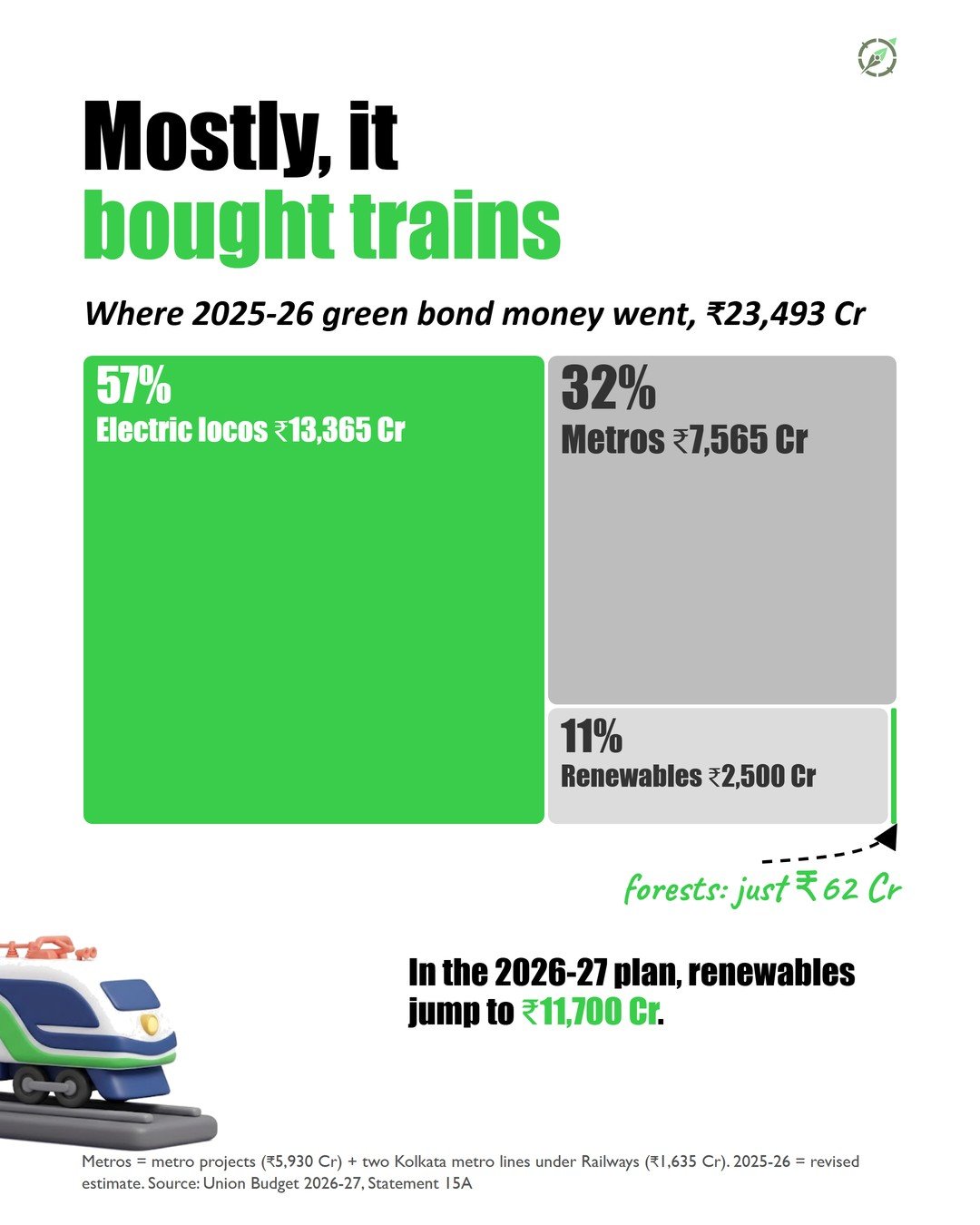
In FY26, 64% of the eligible spending went to railways, mostly electric locomotives. That is about ₹13,365 Cr on locomotives alone.
Metro projects took ₹5,930 Cr, about a quarter of the total. Renewables took only ₹2,500 Cr, about 11%. The Green India Mission, which restores forests, took ₹62 Cr, or 0.3%.
The 2026-27 plan changes that. Renewables rise to ₹11,700 Cr, and rooftop solar alone gets ₹10,000 Cr. Renewables move from 11% of the spending to 38%.
The trains are not a bad use of the money. Electric locomotives cut emissions compared with diesel. But the label has so far meant trains as much as clean energy.
Why won't buyers pay for the label?
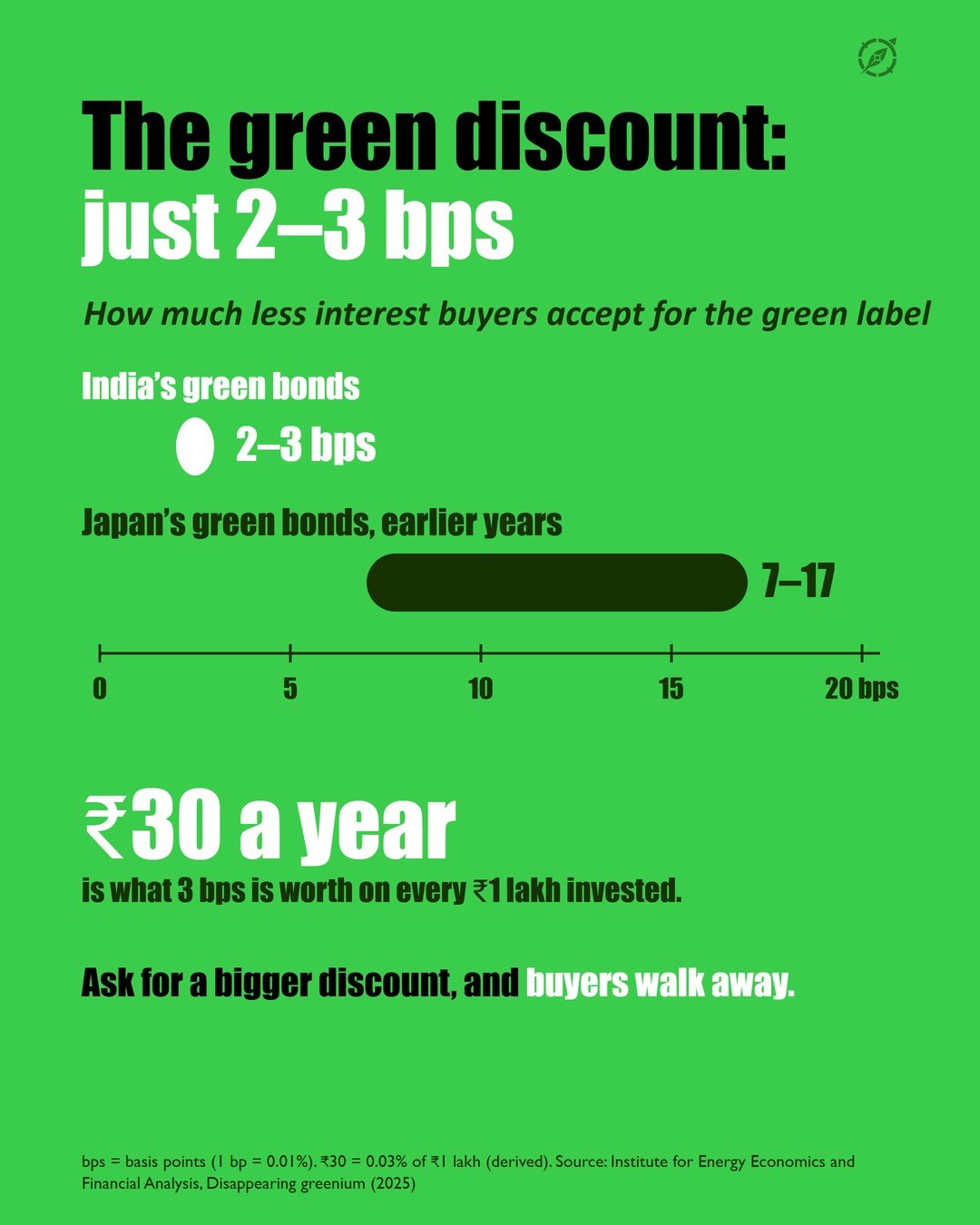
Investors could accept a slightly lower return for a green bond. That discount is called the greenium. In India it is only 2 to 3 basis points, which is 0.02% to 0.03%.
On ₹1 lakh that is about ₹2 to ₹3 a year. It is a thin reward, and it does not pay for the extra reporting.
The auctions show the problem. Bids in the November 2024 auction of a 10-year green bond covered less than a third of the ₹5,000 Cr offered.
Two auctions left ₹7,440 Cr unsold. Primary dealers, the firms that underwrite government auctions, had to take it.
The government has responded by making the auctions smaller. The H2 FY27 tranches are ₹3,000 Cr each, down from ₹5,000 Cr. Smaller servings suggest thinner demand.
How does the world compare?
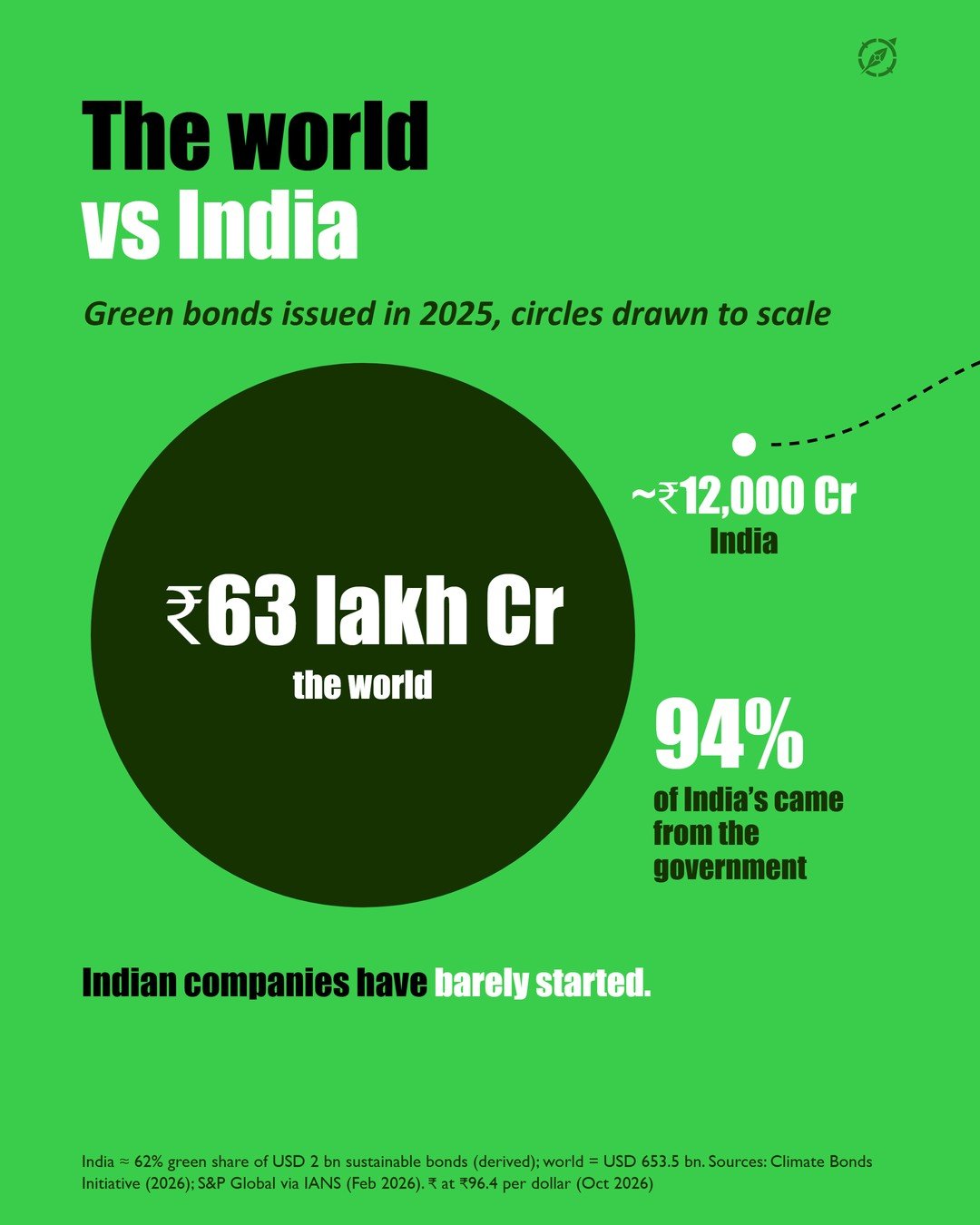
The world issued about ₹63 lakh Cr of green bonds in 2025, the second-highest year on record. All of India's sustainable bonds that year came to about ₹19,300 Cr.
Of India's green bonds in 2025, 94% came from the government. Companies issued almost none. A market with one seller is not yet a market.
The story in 10 slides

Can a business use it?
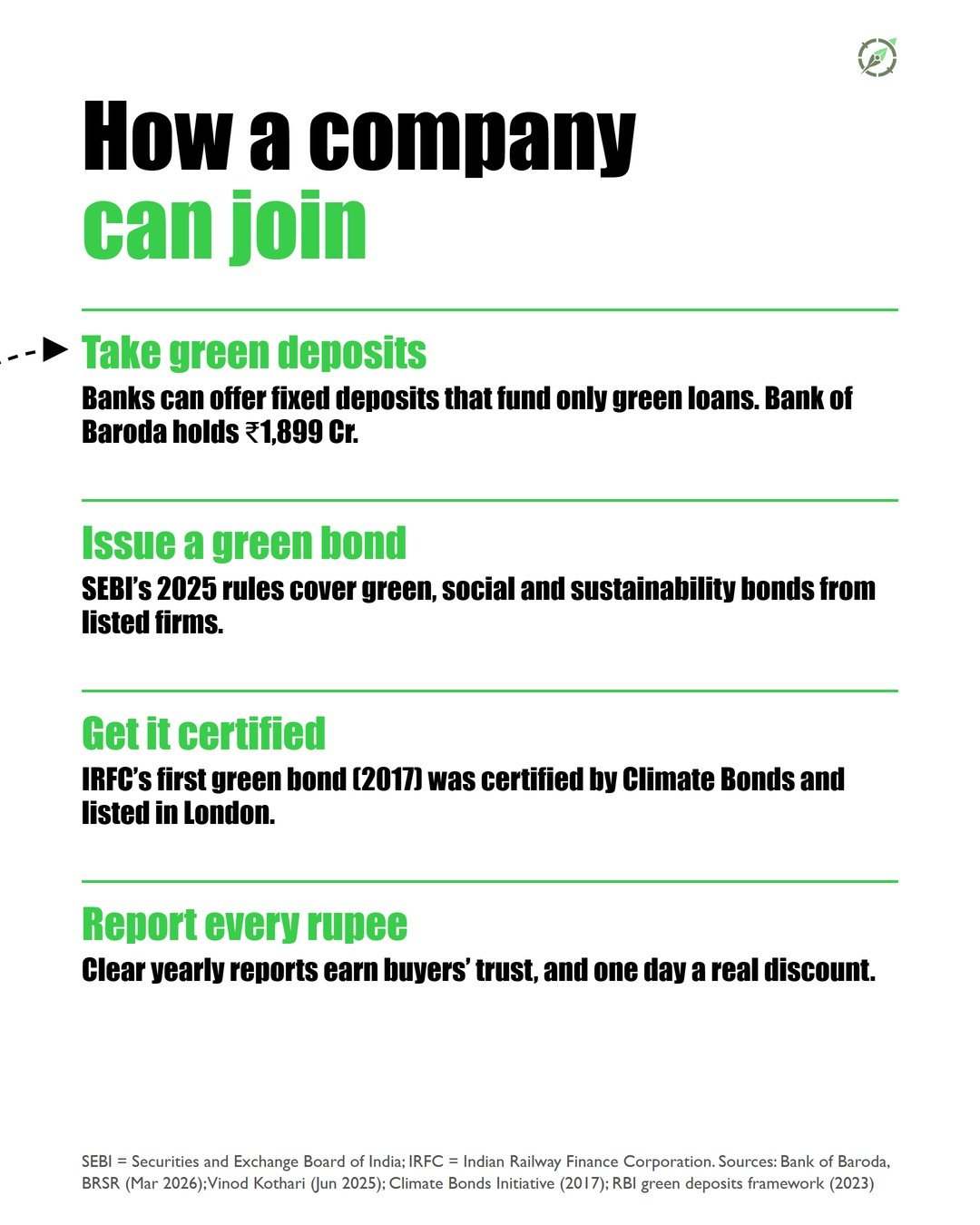
Companies can issue them. Indian Railway Finance Corporation sold a $500 million green bond in 2017. The Climate Bonds Initiative certified it, and it listed in London.
SEBI widened its rules in June 2025 to cover green, social and sustainability bonds. Those rules give companies a clearer route to the market.
Banks have another route. Since 2023 the RBI has let them take green fixed deposits, which may only fund green loans. Bank of Baroda held ₹1,899 Cr of them on 31 March 2026, the most among its peers.
Anyone can buy a sovereign green bond too. Every government auction keeps 5% for retail investors, who can bid through RBI Retail Direct.
How a company can join
- Sell a bond. Companies can issue green bonds, as Indian Railway Finance Corporation did with a $500 million bond in 2017.
- Get it certified. That bond was certified by the Climate Bonds Initiative and listed in London.
- Use the new rules. SEBI widened its rules in June 2025 to cover green, social and sustainability bonds, which gives companies a clearer route to the market.
- Try green deposits. Since 2023 the RBI has let banks take green fixed deposits, which may only fund green loans.
Anyone can also buy a sovereign green bond, because every government auction keeps 5% for retail investors.
Every government auction keeps 5% for retail investors, who can bid through RBI Retail Direct.
The label exists. The buyers are not there yet.
Questions
What is a green bond?
A green bond is an ordinary government bond with one promise. The money can fund only listed green projects.
What is the greenium?
It is the slightly lower return investors could accept for a green bond. In India it is only 2 to 3 basis points, which is 0.02% to 0.03%.
Can I buy a sovereign green bond?
Yes. Every government auction keeps 5% for retail investors, who can bid through RBI Retail Direct.
Sources
- ICMA, Green Bond Principles (June 2025)
- Govt of India, Sovereign Green Bond Framework (2022)
- Union Budget 2026-27, Statement 15A
- DEA issuance calendar, FY2026-27
- World Bank, India's green bonds (2023)
Show the other 10 sources
- IEEFA, Disappearing greenium (2025)
- RBI declines all bids, Angel One (2025)
- CEEW Green Finance Centre (2024)
- Climate Bonds Initiative, 2025 market data
- Indian Railways IRFC green bond, Climate Bonds Initiative (2017)
- RBI green deposit framework (2023)
- SEBI ESG debt framework, Vinod Kothari (2025)
- DEA H2 FY27 calendar, via Devdiscourse (Sep 2026)
- S&P Global via IANS (Feb 2026)
- Bank of Baroda BRSR (2026)
Corrections: none so far. Found a mistake? Email me and I will fix it and note it here.