

India's nuclear targets keep slipping. A new law tries again.
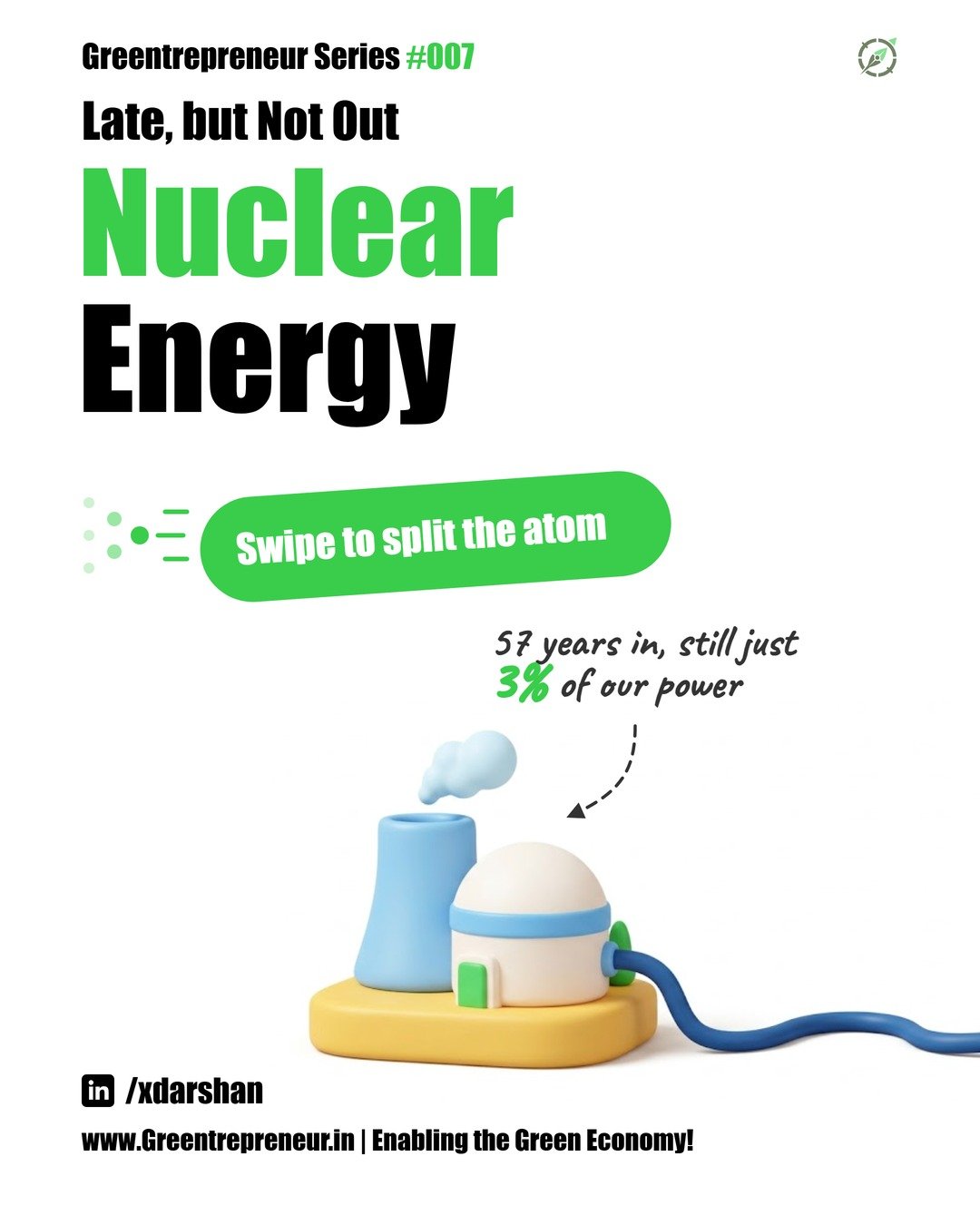
Nuclear gives India about 3% of its electricity. Every target since 1984 has slipped, and a new law now lets private companies in for the first time.
Nuclear is one of the few clean sources that runs day and night. India needs that, because its demand is climbing toward a peak nobody planned for a decade ago.
Key numbers
Sources: Central Electricity Authority (2026); Energy Information Administration; Our World in Data; Press Information Bureau (2026); DERC (2025); PTI (2026).
Why does India need nuclear?
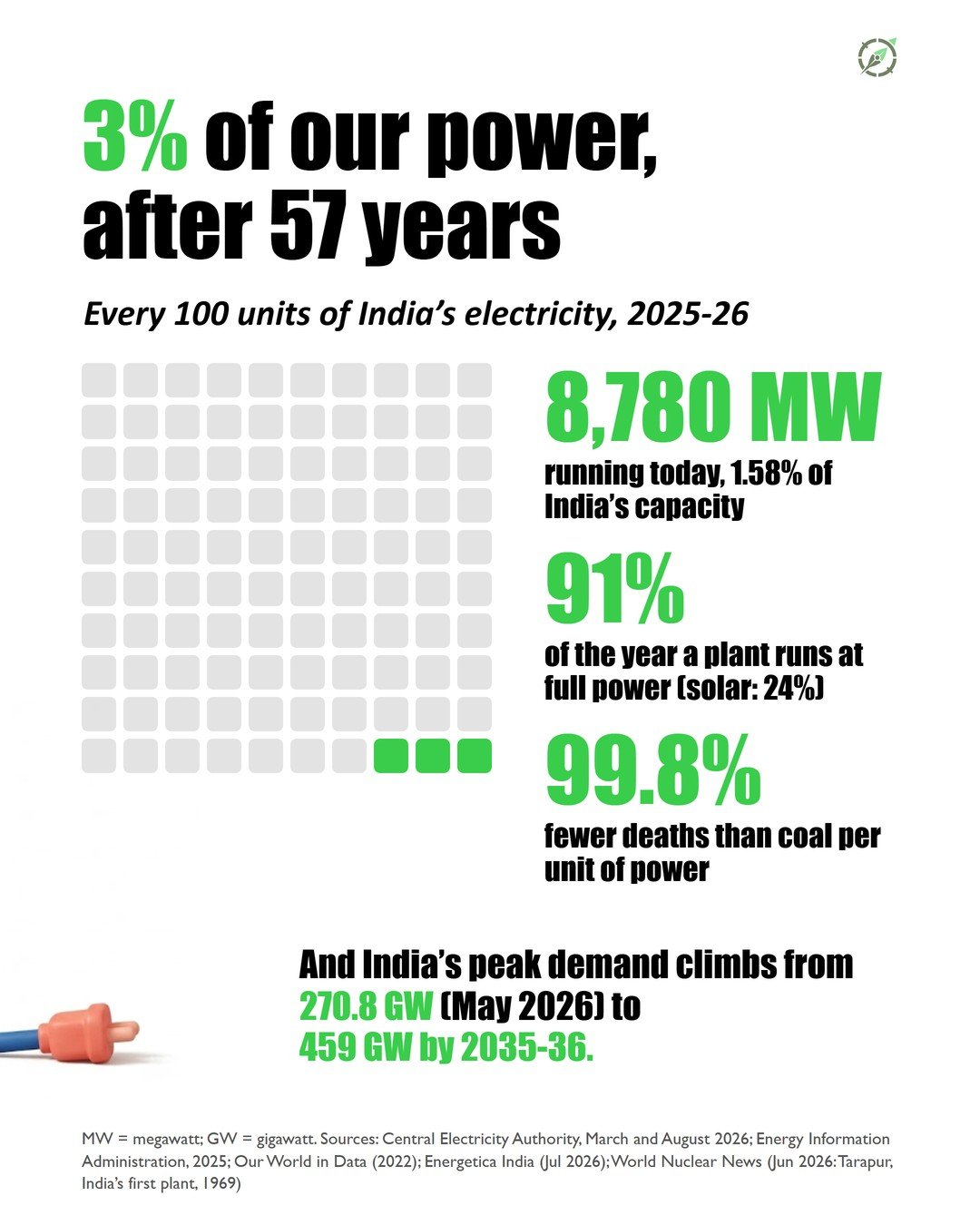
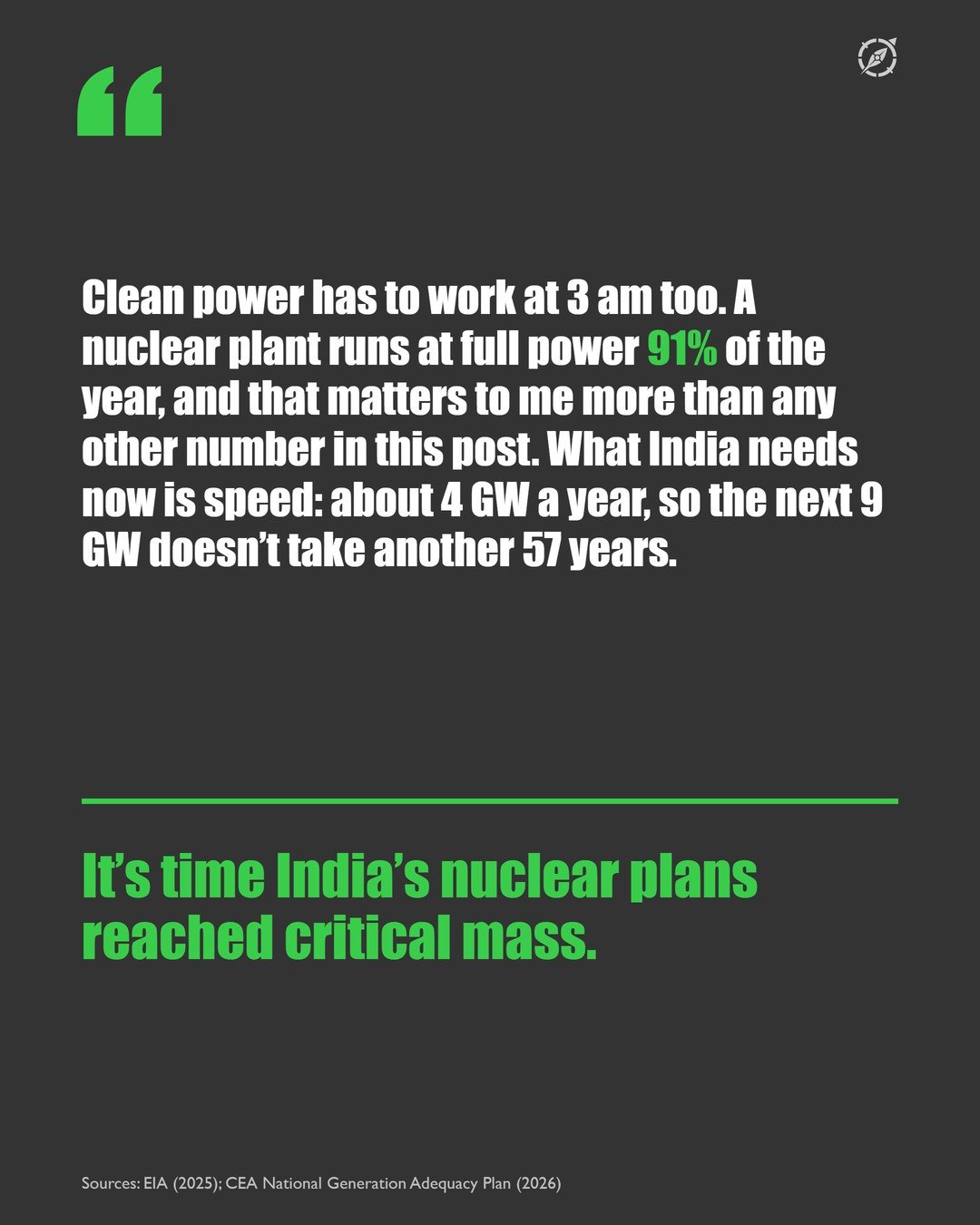
A nuclear plant runs at full output about 91% of the year, according to US data. Solar runs about 24% of the time, and wind about 34%. That steady output is what the grid lacks at night.
India's peak demand hit a record 270.8 GW in May 2026. The Central Electricity Authority expects the grid to meet about 459 GW by 2035-36.
Where does India stand today?
Nuclear supplied 55.19 billion of India's 1,847.94 billion units of electricity in 2025-26. That is about 3%.
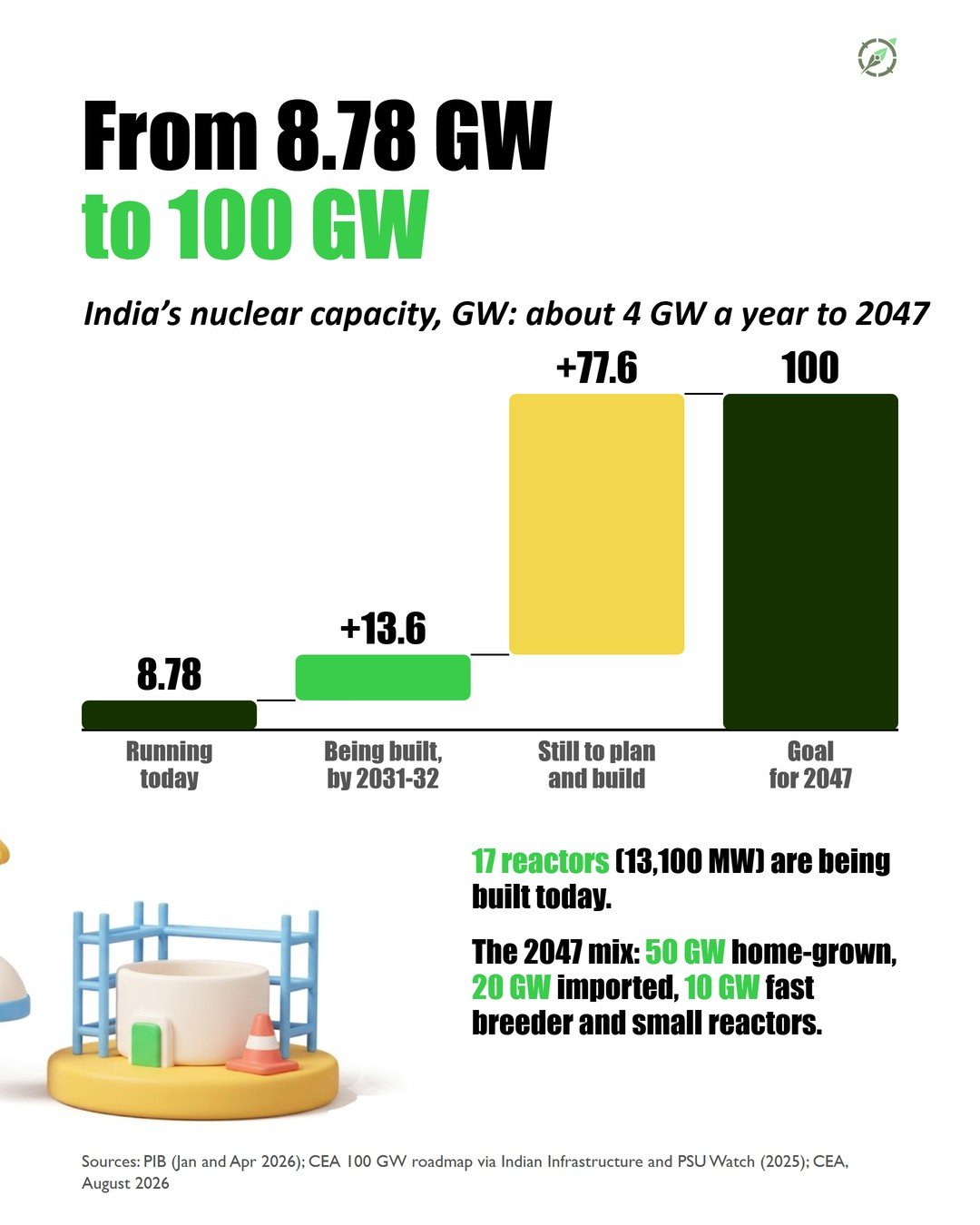
India has 8,780 MW of nuclear capacity, 1.58% of the national total as of August 2026. In January 2026 the country had 17 reactors under construction, with a combined 13,100 MW. That is more than the whole fleet running today.
Two of those projects are close. Fuel loading began at Rajasthan unit 8, a 700 MW home-grown reactor, in September 2026, with commercial power expected this financial year.
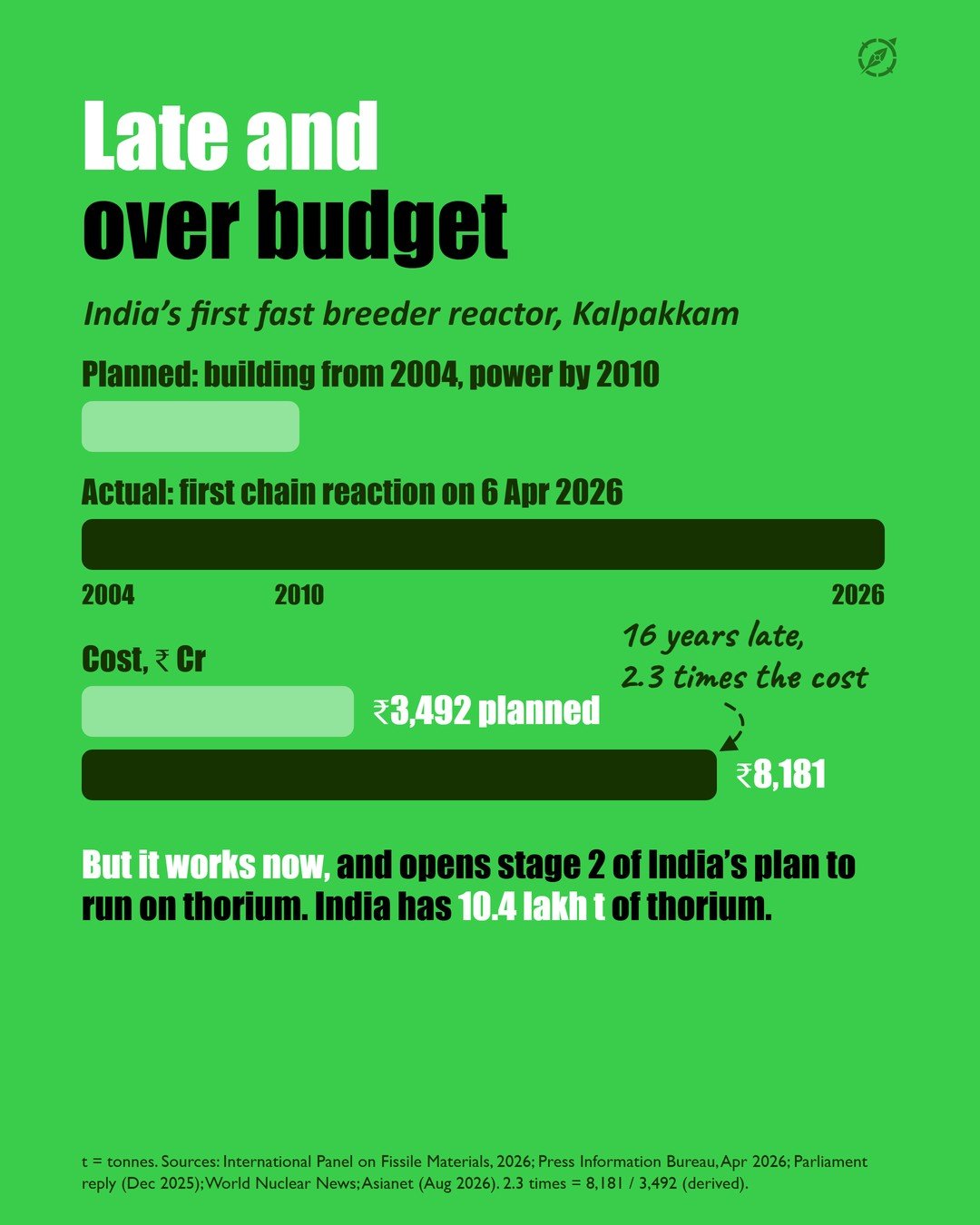
India's first fast breeder reactor, PFBR at Kalpakkam, went critical on 6 April 2026. That starts stage two of the three-stage plan.
Why are the targets always late?
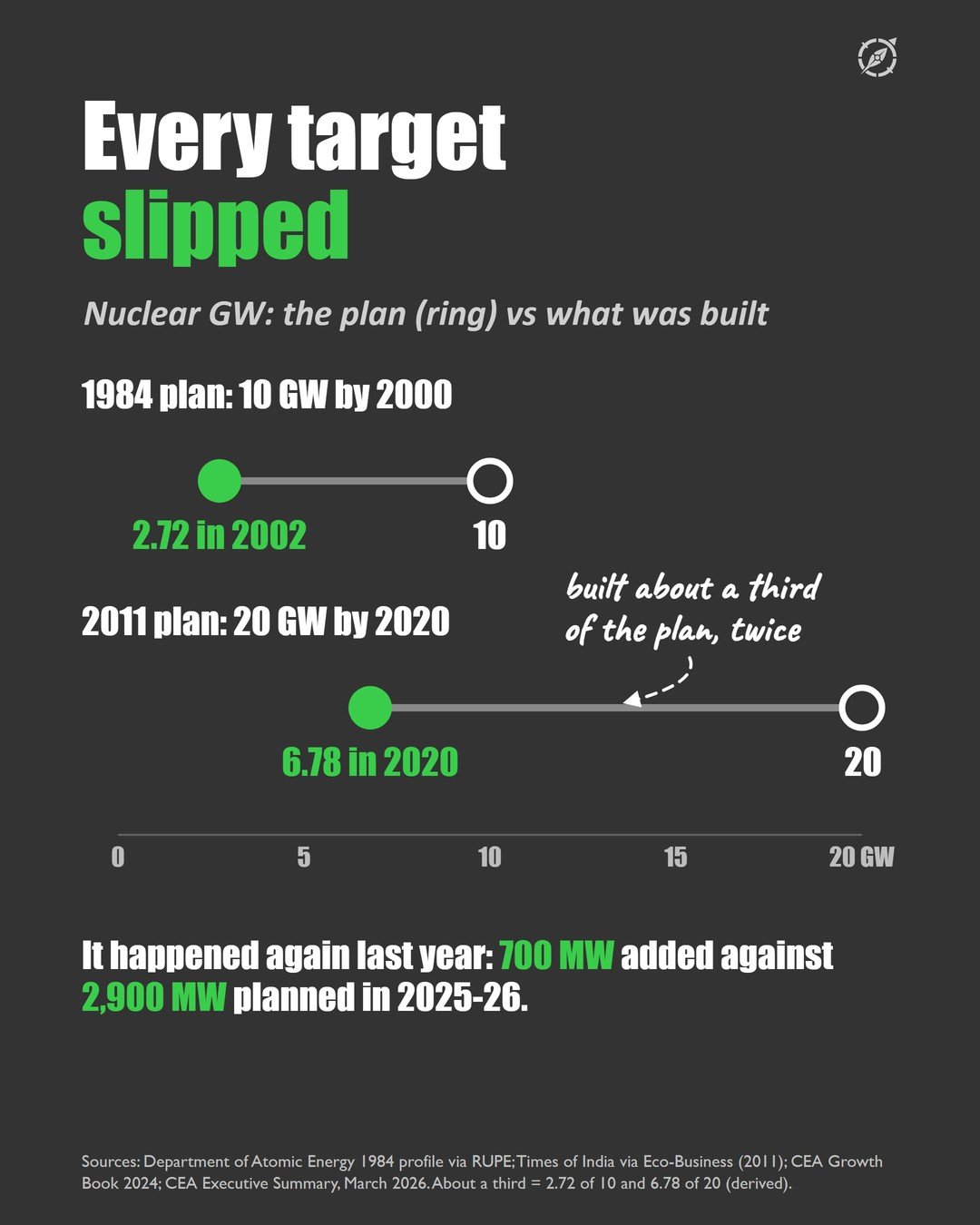
The 1984 target was 10 GW by 2000. In March 2002, the country had 2.72 GW running.
The 2011 target was 20 GW by 2020. In 2020 it had 6.78 GW. The 2025-26 plan was for 2,900 MW of new capacity, and about 700 MW was added.
Costs slipped too. The PFBR was planned at ₹3,492 Cr. Its cost is now ₹8,181 Cr. Construction began in 2004, power was planned for 2010, and criticality came in 2026.
Kudankulam units 3 to 6 now cost about 55% more than planned, at ₹1.38 lakh Cr. The first unit is due in June 2027, after a 2023 promise slipped.
The reactors are not the hard part. Finishing them on time and on budget is.
The story in 10 slides
What changes now?
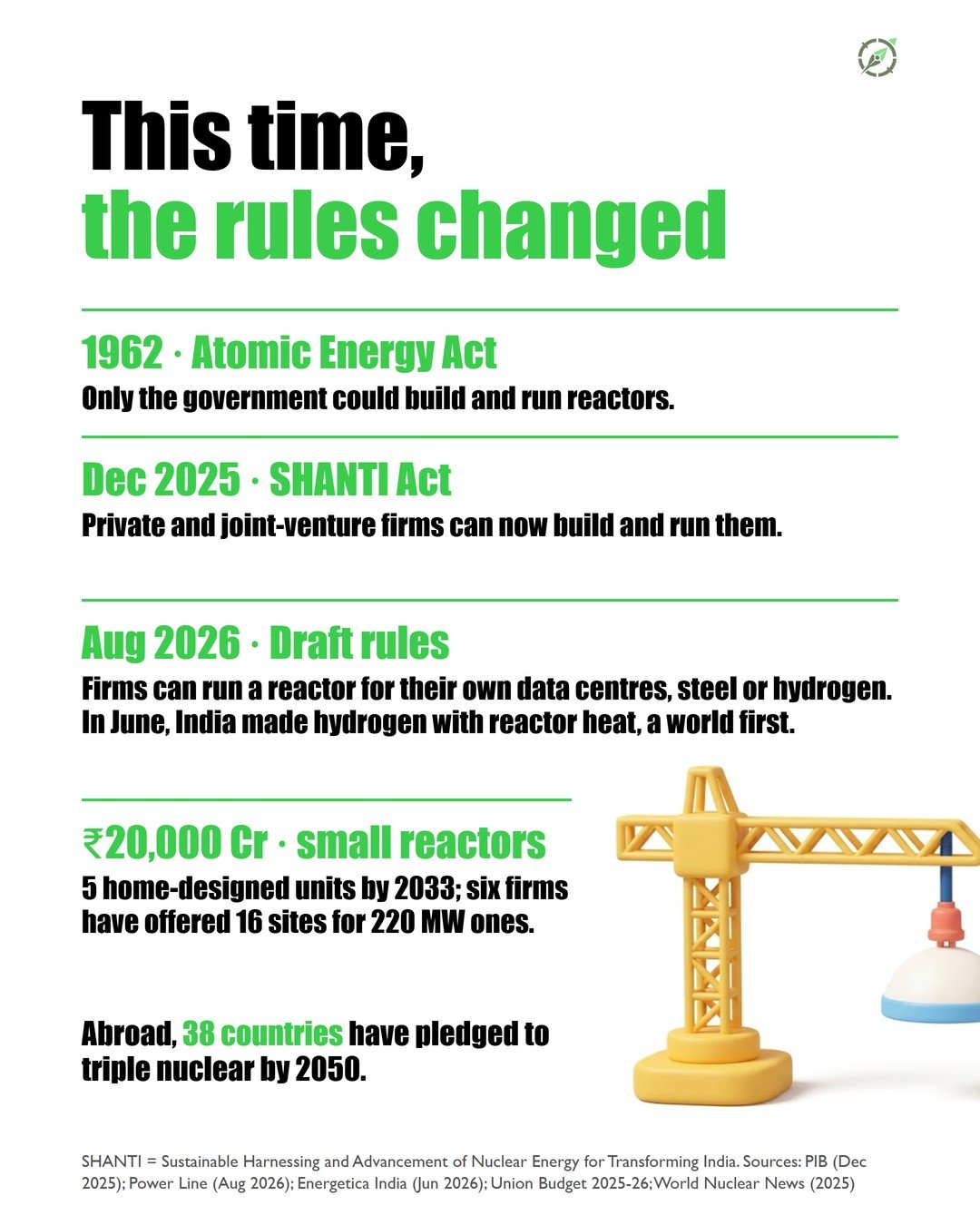
The SHANTI Act of 2025 ends the government's 63-year monopoly on nuclear power. Private and joint-venture firms can now build, own and run reactors.
Liability rules were also changed. Operator caps range from ₹100 Cr to ₹3,000 Cr by plant size, and suppliers are no longer liable. That change is now being challenged in the Supreme Court.
The government has set aside ₹20,000 Cr for small modular reactors, with five home-designed units targeted by 2033. The Bharat Small Reactor scheme drew 16 offered sites from industrial firms including Reliance, Adani, Tata Power and JSW.
The customs duty waiver on nuclear equipment has been extended to 2035, for plants of any size.
What will the power cost?
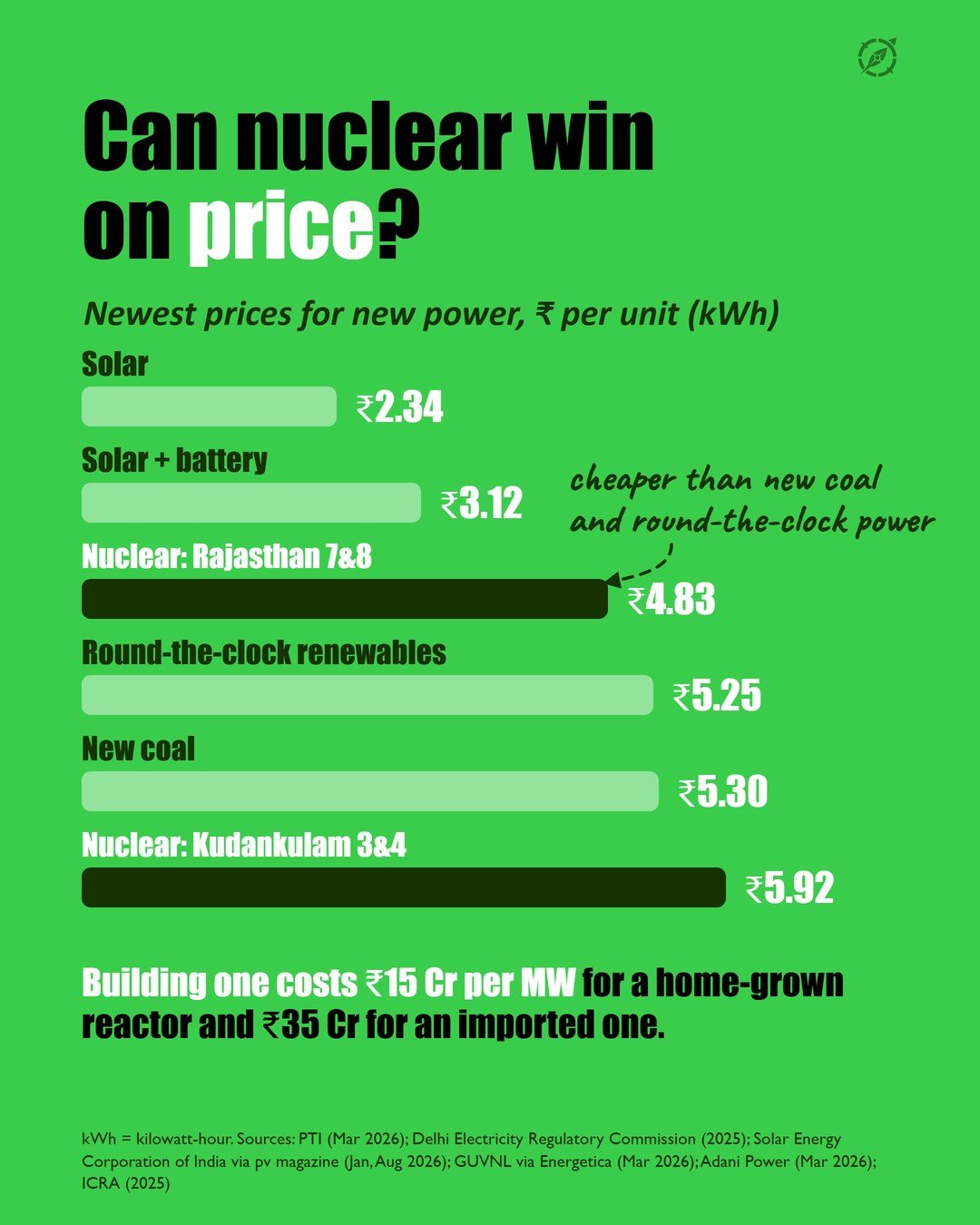
A new Kudankulam unit is priced at about ₹5.92 per unit. The older units were ₹3 to ₹4.10. A home-grown 700 MW design in Rajasthan is tentatively priced at ₹4.83.
The closest rival for steady power is round-the-clock renewables. The newest bid for that is ₹5.25 per unit. Solar with a battery comes in at ₹3.12, and solar alone at ₹2.34.
The cost to build is high too. A home-grown 700 MW reactor costs about ₹15 Cr per MW, against ₹35 Cr per MW for an imported 1,000 MW unit, according to ICRA.
Where does the fuel come from?
About 30% of India's uranium needs come from its own mines. The rest is imported, mainly from Kazakhstan, Russia, Uzbekistan and Canada. India has 4.31 lakh tonnes of known uranium oxide resources.
Its beach sands hold about 10.4 lakh tonnes of thorium. Thorium is the fuel for the third stage of the country's three-stage plan.
Who builds it?
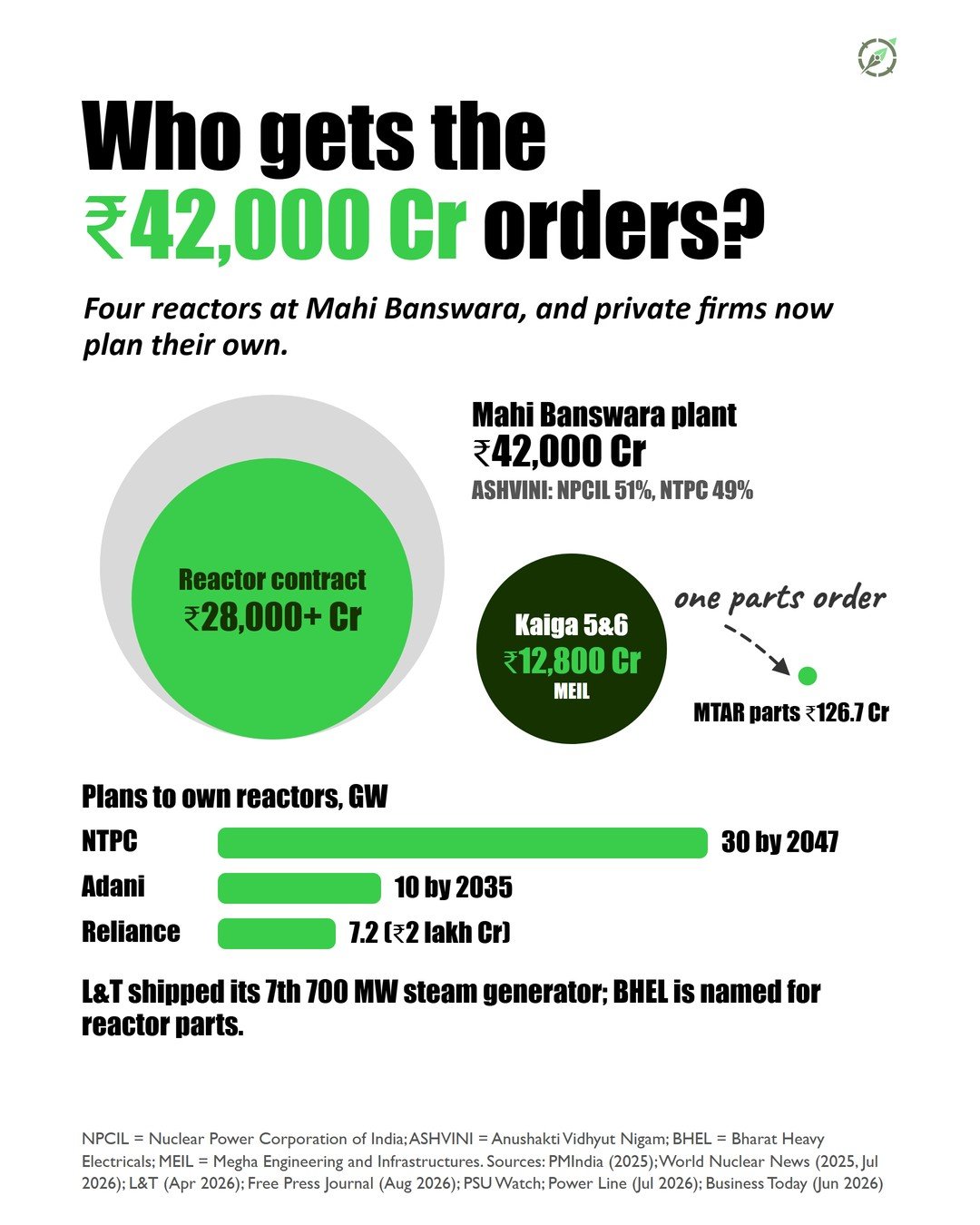
Mahi Banswara in Rajasthan will have four 700 MW units, with a nuclear island contract worth more than ₹28,000 Cr. MEIL won the ₹12,800 Cr contract for Kaiga 5 and 6. L&T has delivered several steam generators for the fleet.
Private plans are large. Adani plans 10 GW by 2035, Reliance 7.2 GW, and NTPC 30 GW by 2047.
Big tech is also buying. Meta has agreed to buy up to 6.6 GW of nuclear power by 2035, and hyperscaler deals in all reach up to 13 GW.
How a company can join in
- Build and own. Under the SHANTI Act of 2025, private and joint-venture firms can build, own and run reactors.
- Know the liability. Operator caps range from ₹100 Cr to ₹3,000 Cr by plant size, and suppliers are no longer liable.
- Try small reactors. The government has set aside ₹20,000 Cr for small modular reactors, with five home-designed units targeted by 2033.
- Secure the fuel. About 30% of India's uranium needs come from its own mines, and the rest is imported.
The customs duty waiver on nuclear equipment has been extended to 2035, for plants of any size.
Meta has agreed to buy up to 6.6 GW of nuclear power by 2035, and hyperscaler deals in all reach up to 13 GW.
Nuclear does not need to be the answer to everything. It needs to be on time.
Questions
How much of India's electricity comes from nuclear?
Nuclear supplied 55.19 billion of India's 1,847.94 billion units in 2025-26. That is about 3%.
What is the SHANTI Act?
The SHANTI Act of 2025 ends the government's 63-year monopoly on nuclear power. Private and joint-venture firms can now build, own and run reactors.
How much does nuclear power cost per unit?
A new Kudankulam unit is priced at about ₹5.92 per unit. The older units were ₹3 to ₹4.10.
Sources
- US EIA, Electric Power Monthly (2025)
- CEA Executive Summary, March 2026
- CEA Installed Capacity Report, August 2026
- PIB, Parliament reply on nuclear reactors (Jan 2026)
- PIB backgrounder on nuclear (Apr 2026)
Show the other 23 sources
- World Nuclear News, Indian plant milestones (Sep 2026)
- World Nuclear News, tripling pledge (2025)
- IPFM, India's prototype fast breeder reactor (Apr 2026)
- India's nuclear roadmap, PSU Watch (2025)
- SHANTI Act text, CEA
- Union Budget 2026-27 speech
- Bharat Small Reactor request for proposals, World Nuclear News (2025)
- DERC order on Rajasthan 7&8 tariff (2025)
- ICRA rating rationale on nuclear (2025)
- Parliament panel on uranium, World Nuclear News (Aug 2026)
- Thorium reserves, Parliament reply (Dec 2025)
- Mahi Banswara project, PMIndia (2025)
- Kaiga 5 and 6 contract, World Nuclear News (2025)
- CEA peak demand projection, Mercom India (2026)
- RUPE, DAE 1984 profile
- India's 20,000 MW nuclear plan, Eco-Business (2011)
- Kudankulam cost rise, Bloomberg via EnergyConnects (Jul 2026)
- Kudankulam 3&4 indicative tariff, PTI (Mar 2026)
- SECI 1 GW round-the-clock tender, pv magazine (Aug 2026)
- Uranium resources, citing AMD (Aug 2026)
- L&T steam generator dispatch (Apr 2026)
- Private nuclear plans, Power Line (Jul 2026)
- Meta nuclear deals, American Nuclear Society (Jan 2026)
Corrections: none so far. Found a mistake? Email me and I will fix it and note it here.